Georgia lawmakers approve income tax cut, property tax relief
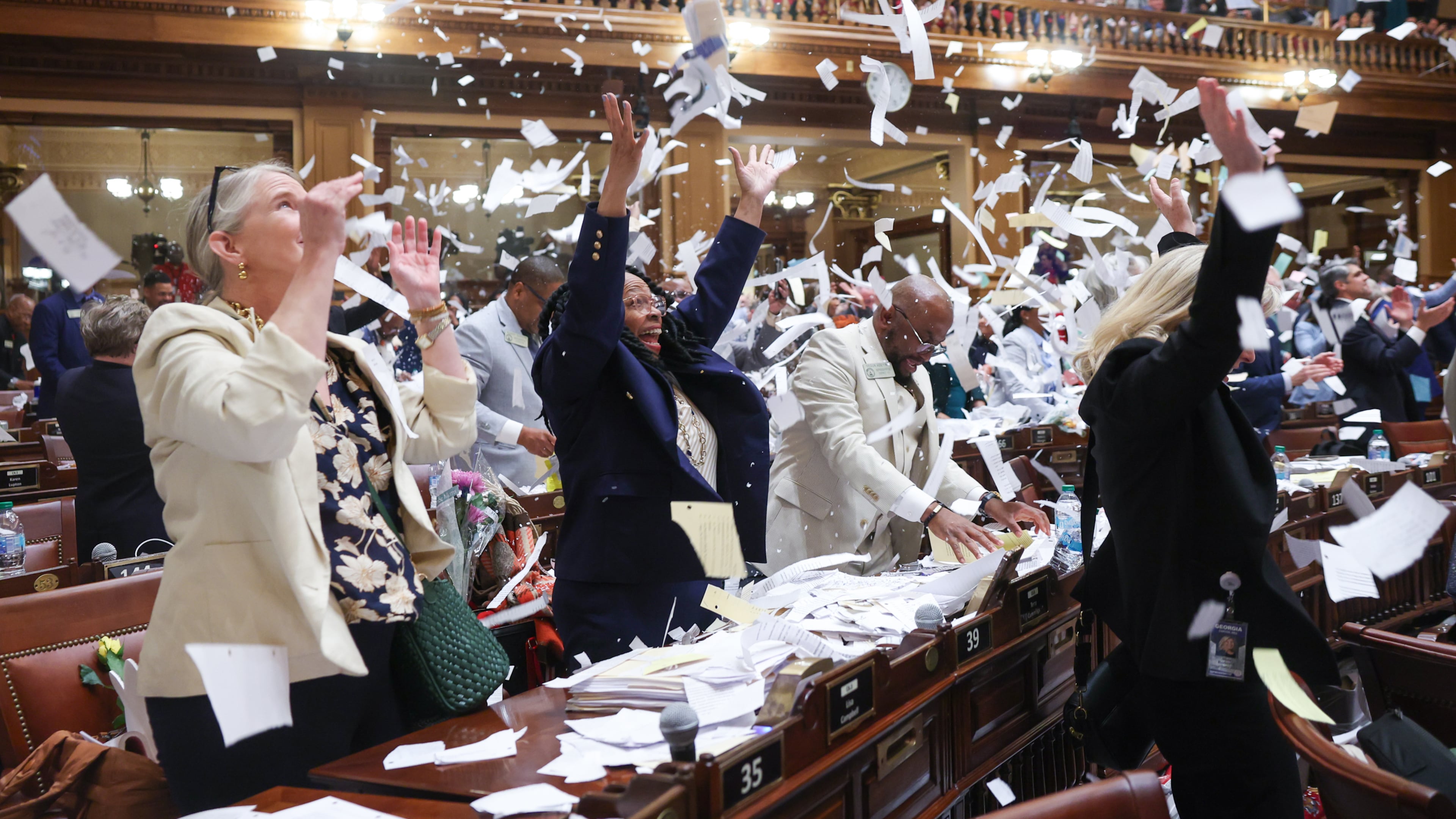
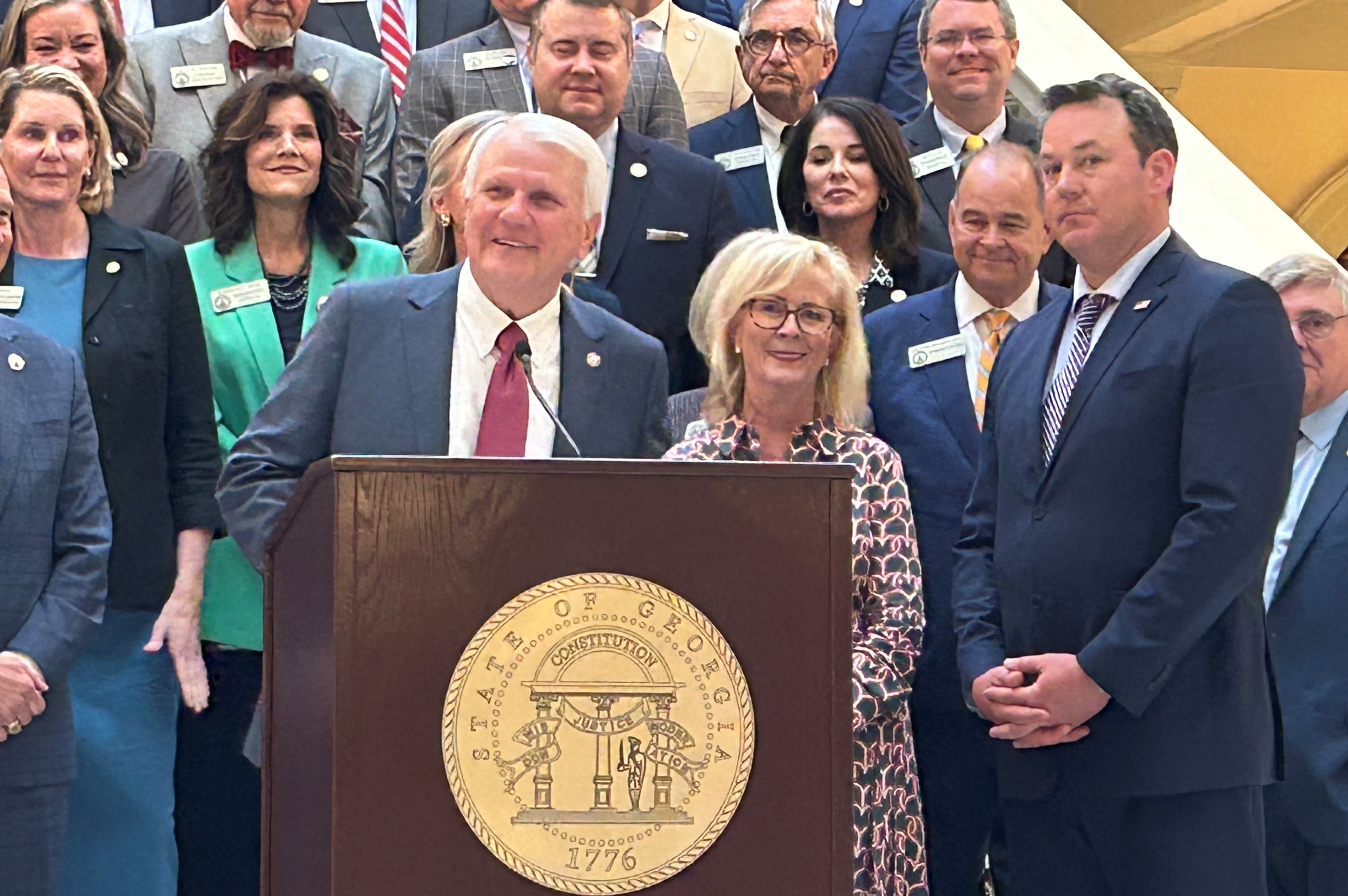
The General Assembly late Thursday approved a significant income tax cut and a scaled-back proposal for property tax relief.
Lawmakers also approved a $38.5 billion spending plan that boosts funding for children’s literacy, retiree pensions and other priorities.
But the state House and Senate adjourned Sine Die without voting on a proposed overhaul of the state’s voting systems or a switch to hand-marked paper ballots, leaving the possibility of there being no legal way to count most votes in the midterms.
The flurry of activity came in the waning hours of a legislative session dominated by efforts to address voter concerns about affordability.
House Bill 463 would reduce the state’s income tax rate from 5.19% to 4.99% this year and continue to reduce it to 3.99% over the following eight years if the state meets certain financial benchmarks.
The bill also would raise the standard deduction for married couples filing jointly from $24,000 to $30,000 next year and the deduction for other filers from $12,000 to $15,000. The bill also would exempt up to $1,750 in cash tips and $1,750 in overtime income from taxation.
Georgia’s 2026 legislative session wraps up
Major bills: Georgia lawmakers approve income tax cut, property tax relief
What’s next: At state Capitol, affordability was the agenda. Now it’s the campaign battle.
Staying in time: Georgia won’t switch to Atlantic Standard Time after all
Opinion: Gov. Brian Kemp takes one last lap at the Georgia Legislature
Bill tracker: What passed and what fell short
Bad blood: Burt Jones putting the squeeze on top GOP rival Rick Jackson
Recap: How Sine Die unfolded at Georgia Capitol
Opinion: The good, the bad and the truly ugly of the 2026 legislative session
Sine Die Seder: Why this night was different from all others
Confederate monuments: Bill to protect Confederate memorials narrowly fails in Georgia House
Complete coverage: Georgia legislative session
“I am tired of watching my neighbors, watching my colleagues, watching people who I don’t know but I pass in a grocery store having a hard time making ends meet and not being willing to do something,” Appropriations Chairman Blake Tillery, R-Vidalia, told senators. “This bill does something.”
Opponents said the proposal would blow a $6.5 billion hole in the state budget over time and primarily benefit wealthy Georgians.
“It’s a completely fiscally irresponsible bill,” said Sen. Josh McLaurin, D-Sandy Springs.
On voting, lawmakers never answered how Georgia would comply with a state law passed two years ago to eliminate QR codes from ballots by July. Proposals to delay implementation or to do away with Georgia’s touchscreen voting machines in favor of hand-marked paper ballots fell short of the finish line.
“I expect that we may be called back into a special session to address the issue before July,” state Rep. Victor Anderson, R-Cornelia, said. “The only other alternative I could see is that it’ll get challenged and hopefully settled in court.”
Speaking to reporters in the wee hours Friday morning, House Speaker Jon Burns left open the possibility of returning later in the year.
“You know it’s been a long day, and so I’m going to contemplate a lot of things and try to figure out where we may be,” he said. “But I think we left a couple things left out there that are a little troubling, but we’re going to deal with that.”
He said the House passed a “reasonable” election bill to create a path forward.
“We’ll sit down with the governor and take his temperature on where we need to be. Certainly election reform is something we’re committed to. We think we had a reasonable plan that would allow us to move forward with our elections and have transparency,” he said.
The election bill that did pass would transition the state from the current touchscreen voting system to a new system by 2028. The new system would allow for hand-marked paper ballots to be printed on demand at polling locations as a possible solution. But that wasn’t a guarantee.
“We don’t want to limit the next secretary of state and his advisory committee on one option if there is an option that is the better option for the state of Georgia,” Anderson said before the vote.
The Senate rejected a House proposal to significantly reduce property taxes for homeowners — a top priority of Speaker Jon Burns. But it later approved a scaled-back measure, and the House agreed to the Senate proposal.
House Bill 1116, would have capped the growth of school and local government property tax levies at 3% a year or the rate of inflation, whichever is higher. The measure also would have allow schools and governments to implement sales taxes to reduce property taxes for homeowners.
But the Senate rejected that bill. Instead it approved Senate Bill 33, which establishes the sales taxes for property tax relief but does not include the 3% cap on levies. The bill does limit the growth of property tax assessments of individual properties to 3% or the rate of inflation.
On the last day of the legislative session, lawmakers also:
- Approved a $38.5 billion 2027 budget that funds key priorities of both chambers. The Senate won $100 million in additional funding for the Employee Retirement System of Georgia. Tillery said the new funding could be enough for a 2.25% raise, though any cost-of-living adjustment would have to be approved by the retirement system board.
- Allotted $70 million in funding for literacy coaches in all of the state’s elementary schools. The money will be funneled through the state’s basic education funding formula, which means local districts will be required to match some of it.
- Passed a bill that would make the antiparasitic medication ivermectin available without a prescription.
Ivermectin became well known during the pandemic for false claims that the drug could be used to treat COVID. State Rep. Michelle Au, a Democrat from Johns Creek and an anesthesiologist, warned that ivermectin has not been approved by the U.S. Food and Drug Administration for treatments against COVID-19 or cancer.
“There is a risk — no matter what the medication — when you take medications for the wrong reason,” she said.
House Majority Whip Rep. James Burchett, R-Waycross, said he agreed with Democrats over concerns that people could misuse drugs for unproven treatments.
“But I don’t think that’s justification for restricting access,” he said. “This is fundamentally a patient choice and medical freedom bill.”
The first bill to pass the Legislature on Thursday mourned the death of the penny, which ceased production last year. Lawmakers addressed the dwindling 1-cent supply by allowing retailers to round prices to the nearest nickel when making change and calculating sales taxes on cash sales.
Thursday was also a chance for numerous elected officials to say goodbye to their colleagues. Some are retiring or leaving to run for higher office.
Among those saying farewell was Gov. Brian Kemp. Flanked by his wife, Marty, and their three daughters, he compared House lawmakers to a family.
“Well, here we go,” he said, scanning the chamber, “together again for one last ride.”
Kemp thanked lawmakers for backing the dozen or so anti-human trafficking measures his wife championed. He touted what he called “historic investments” in infrastructure. And he applauded them for working to preserve the state’s budget surplus and slash taxes.
“Not bad for government work, if you ask me.”
Staff writer Greg Bluestein contributed to this report.
About the Authors

David Wickert writes about the state budget, finance and voting issues. Previously, he covered local government and politics in Gwinnett and Fulton counties. Before moving to Atlanta, he worked at newspapers in Illinois, Tennessee, Virginia and Washington.

Caleb Groves is a general assignment reporter for The Atlanta Journal-Constitution's politics team and a Kennesaw State University graduate.

Riley Bunch is a reporter on the local government team at The Atlanta Journal-Constitution covering Atlanta City Hall. She covers the mayor and Atlanta City Council while also keeping an eye on the city’s diverse neighborhoods.
More Stories
The Latest