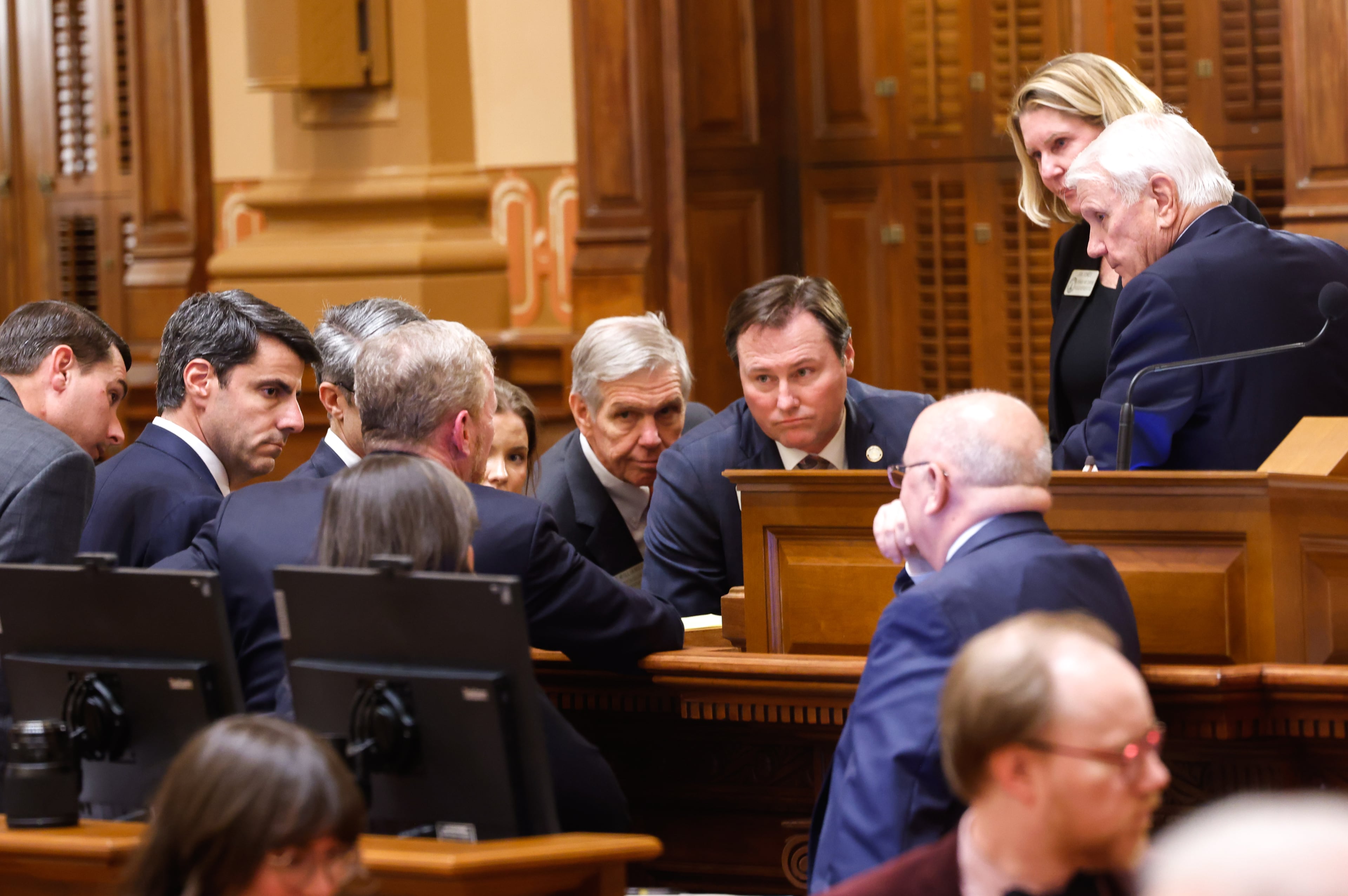
With dollars scarce, lobbying is intense
It’s lobbyist full employment time at the General Assembly, or at least that’s how some old hands in the Capitol refer to this crazed period every year when the session’s top issues get decided.
With the state budget in a seemingly perpetual swoon, however, the lobbying frenzy has a different — and, potentially, more fierce — tone. When it comes to state spending, the typical effort to direct state dollars in one direction or the other has largely shifted to an all-out effort to avoid cuts or taxes. But as in most years, there are other issues that have the third floor of the Gold Dome abuzz.
The atmosphere is more charged, as well, as lawmakers consider reforms to curb lobbyist influence after the December scandal that saw the speaker of the House resign after his ex-wife’s allegation that he had an affair with a lobbyist.
One only need mix the budget crisis, a controversial telecom bill, a fight over tobacco taxes and hospital fees, proposed college cuts and the promise of ethics reform to ratchet up the tension.
Consider: In January this year, as the session was just getting started, lobbyists spent $163,000 on gifts and meals for lawmakers. In February, the most recent month for which records are available, that figure balloons like a lobbyist bar tab to $347,000.
But for both months combined, a handful of bills have dominated the discussion and the dollars. Lobbyists involved in the telecom bill now headed for conference committee; a proposed tobacco tax increase; the governor’s plans to tap hospitals for more revenue; and a protracted spat over higher education spending have accounted for more than a quarter of all lobbyist spending.
It’s that time of year, lobbyists and lawmakers said.
Rep. Rusty Kidd (I-Milledgeville) knows this better than most. Before winning a special election for House District 141 last year, Kidd was a veteran Capitol lobbyist, representing tobacco companies, medical associations and other clients.
The Gold Dome is a hive of activity, Kidd said, as one of two major deadlines looms. Any bill that doesn’t move from the House to the Senate, or vice versa, by the 30th day of the legislative session is essentially dead for the year. Under the current schedule, Day 30 will be March 25. The second deadline is the 40th and final day of the session.
“It’s always like this,” Kidd said. “The tension gets up.”
But, Kidd said, when the state budget is as bad as it is now, the tension shifts and gets more intense as attention, and the spending, around other issues grows more focused.
Consider the massive telecom bill, HB 168, headed for a conference committee, which now pits AT&T and smaller phone companies against cable giants like Comcast. In February alone, lobbyists on either side of the fight spent nearly $12,000 on lawmakers.
Among the legislators who received meals were state Rep. Clay Cox (R-Lilburn), the original sponsor of the bill in the House, and Sen. David Shafer (R-Duluth), who carried the bill in the Senate. Cox had a $93 dinner with an AT&T lobbyist and a $12 lunch with a Cable Television Association lobbyist. Shafer had lunch with lobbyists from three smaller phone companies, each of whom reported it costing them $33.
Cox said lobbyists on either side of the telecom bill have largely targeted members who are still on the fence and have left him alone. “And for that I thank God every day,” Cox said. Efforts to reach Shafer on Tuesday were unsuccessful. He was not in the chamber when the Senate began its day and did not return a telephone message or an e-mail request for comment.
Cox’s experience illustrates one direction lobbyist spending can take. That is, it sometimes more closely resembles the cover-all-bases method. For example, Sean Collins, a lobbyist for Altria, the conglomerate that owns tobacco company Philip Morris, reported spending more than $35,000 on Feb. 1. His report filed with the State Ethics Commission doesn’t denote on whom he spent the money. It says the money went to “grass-roots lobbying” on HB 39, Rep. Ron Stephens’ plan to add $1 in taxes to a pack of cigarettes, a bill the tobacco industry opposes.
There is money being spent on both sides of the issue. The Georgia Alliance of Community Hospitals, which favors the tax as a way to offset cuts to Medicaid and as a new source of state revenue that might offset cuts to hospitals, has taken the more targeted approach. Alliance lobbyist Julie Windom spent $500 on meals and drinks for a handful of lawmakers, including chief House budget writer Rep. Ben Harbin (R-Evans). Windom’s colleague Monty Veazey spent another $900.
In some cases, it’s taxpayer money flowing to lawmakers. As the state’s public colleges and universities are told to prepare for massive cuts, their lobbyists jump into action.
Lobbyists for the University System of Georgia and individual schools spent $9,000 on meals, tickets and knickknacks for lawmakers in February. That includes more than $250 for a lunch for the Senate Green Door Committee, a collection of the Senate’s top leaders.
Other issues, such as transportation, still get their share of attention, even if it’s less frenzied. Rep. Jay Roberts (R-Ocilla) is serving his first full session as chairman of the House Transportation Committee. With a major transportation funding bill working through the House, he’s a popular figure along the rope line separating lawmakers from lobbyists during session.
Before becoming a committee chairman, however, Roberts was the Republican caucus chairman, which also made him a high-priority target, but for a wider variety of lobbyists.
The difference? “It’s a lot more focused this time,” said Roberts, who was feted with nearly $800 in gifts and meals in January and February, up about $100 from the same period in 2009.
Overall, lobbyist spending is down in 2010. In January and February of 2009, lobbyists spent more than $700,000, compared to about $510,000 in the same period this year.
However, there’s still too much money in the game, Sierra Club lobbyist Mark Woodall said, and that creates an uneven playing field.
“We can’t fly these folks to the Final Four or buy NASCAR tickets,” Woodall said. He wants to see the ethics reform legislation now brewing behind closed doors to include a “no cup of coffee” rule.
“I don’t think lobbyists ought to spend a dime on these lawmakers,” he said, although he has spent about $120 on books and calendars for a handful of lawmakers.
Charlie Watts, a veteran lobbyist who represents bankers and coroners, among other clients, is a former lawmaker who chaired a banking committee in the House. Because the budget is in such a sorry state, there’s less jockeying among lobbyists for state dollars, he said. But that makes lobbying against cuts more intense, he said.
Watts said he and other lobbyists who aren’t part of the fight over major issues, like telecom and hospital taxes, and who aren’t seeking budget help are mostly observers at this point. He estimates that covers 80 percent of all lobbyists who are trying to make sure their clients stay safe.
“I don’t know I’ve seen a year like this in my 28 years,” Watts said.
Put your money down
Here’s a look at money spent by lobbyists on four key policy issues this year.
Tobacco tax: $44,000 by opponents of a tax increase. More than $70,000 spent by insurance companies, many of which support the tax increase.
Hospital fees and taxes: More than $6,700 by hospitals and hospital associations who fear paying more in fees.
Cuts to colleges: Nearly $9,000 by colleges and universities as they fight for relief.
Telecom: Almost $12,000 by phone and cable companies in a tug-of-war.
Source: State Ethics Commission.
NOTE: Figures do not include all spending by contract lobbyists, only those directly employed by companies or associations.