
Meet the Cornelia ‘community architect’ turning history into art


There’s a woman’s smiling face on a wall in Cornelia, printed on aluminum, boldly colored enough to see from the amphitheater being built a block away in this northeast Georgia town.
Everyone who grew up on the Hill — Cornelia’s historically Black neighborhood, where the mural’s creator, Audrey Davenport, was raised — remembers her as Miss Sally.

Miss Sally’s Cafe — which started in Sally Martin’s home, then moved into a downtown storefront in the 1960s — was beloved for split and grilled hot dogs, topped with the best coleslaw in town, and a jukebox playing R&B and soul back when local stations mostly offered country or Christian. Miss Sally moved to New Jersey around 1987 to live with her sister, and though others rented the space off and on afterward, it was never quite the same.
Davenport, who holds two architecture degrees from the Savannah College of Art and Design, chose Martin’s portrait and story to kick off “Brushstrokes of Change,” a 12-panel installation adorning Cornelia’s Jim Smith Park that tells the stories of the town’s historically Black community. She calls herself a “community architect,” a title she made up because nothing else quite fit.
Designing life
As a girl, Davenport was drawn to how people and places fit together, poring over community floor plans and community photos. As a teenager, she borrowed a stack of family portraits dating to the late 1800s from an Atlanta cousin. “How long can I keep them?” she remembers asking. “As long as you take care of them,” came the answer. She still has them today.
After years spent designing for corporate clients — a career that wound down in the early 2000s — Davenport turned that same discipline toward home: her neighbors were the client this time.
“You start with the place before you build anything,” she said of the numerous town hall sessions and workshops she leveraged to gather stories and consensus about what mattered most to her neighbors. “The first thing you do is establish a relationship with the people who make things happen. You determine who are the pillars, who is the steel, the wood.”
Davenport’s facilitator instinct shows up in small moments: using Google Translate to invite a group of isolated Spanish-speaking women to join a community park event, or flying a Philadelphia muralist in for a town hall to talk about their craft.
Davenport earned two architecture degrees from the Savannah College of Art and Design, between 2004 and 2009. The summer before her master’s year, she served as interim executive director of Savannah’s Ralph Mark Gilbert Civil Rights Museum.
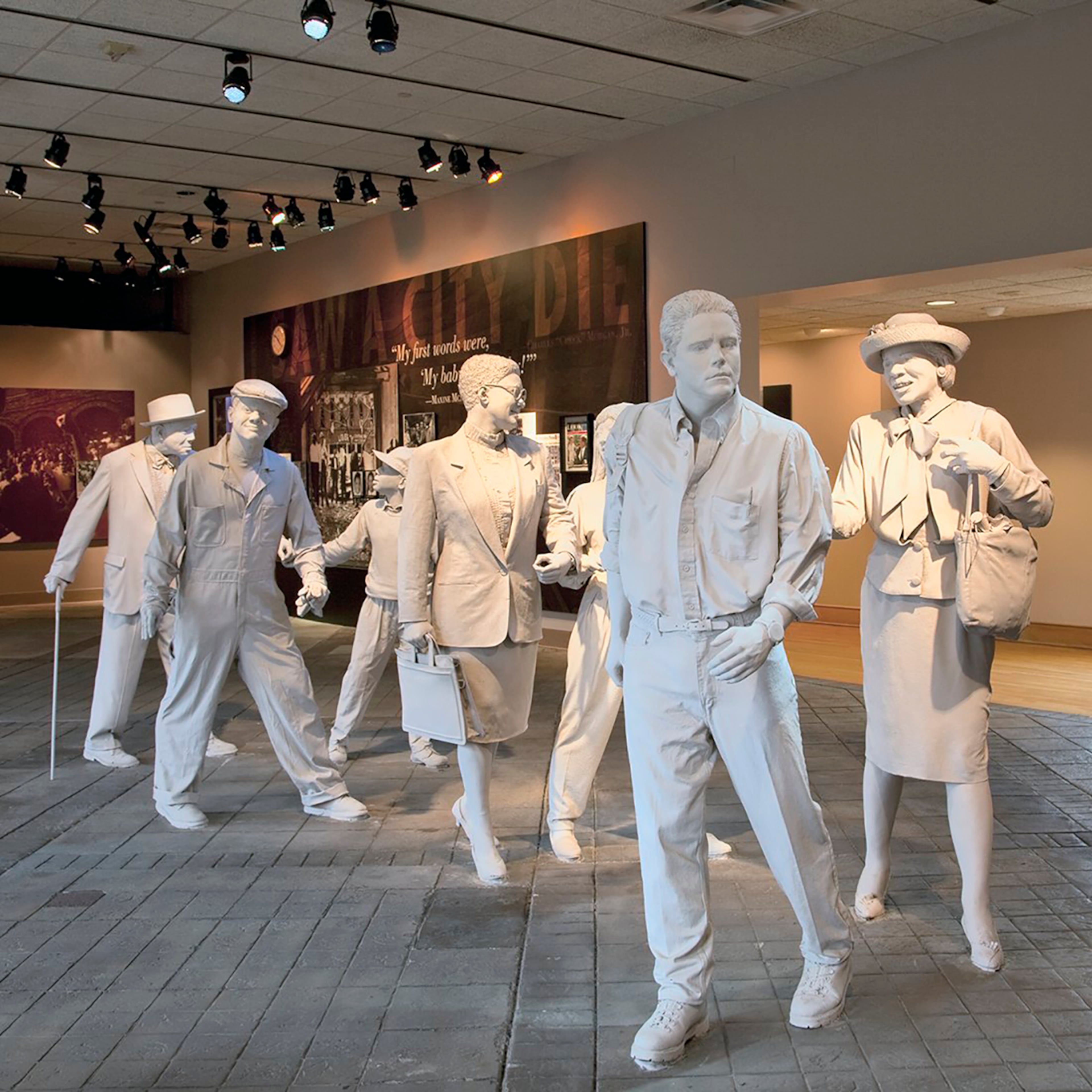
Her master’s thesis took her social justice instincts further, dissecting the impact of the stretch of Savannah’s I-16 highway built straight through a once-thriving Black neighborhood. She’d watched the same pattern play out in cities she knew — Los Angeles, Atlanta — and started seeing it reach rural communities, too.
Returning home
Davenport moved back to Cornelia in 2010 to help care for her mother. Not long after, she was recruited to help organize and design a growing archive of local Black history. That work connected her to the Habersham County Historical Society, where her own childhood pediatrician named her executive director in 2017. The resulting collection is now part of a Digital Library of Georgia pilot program.

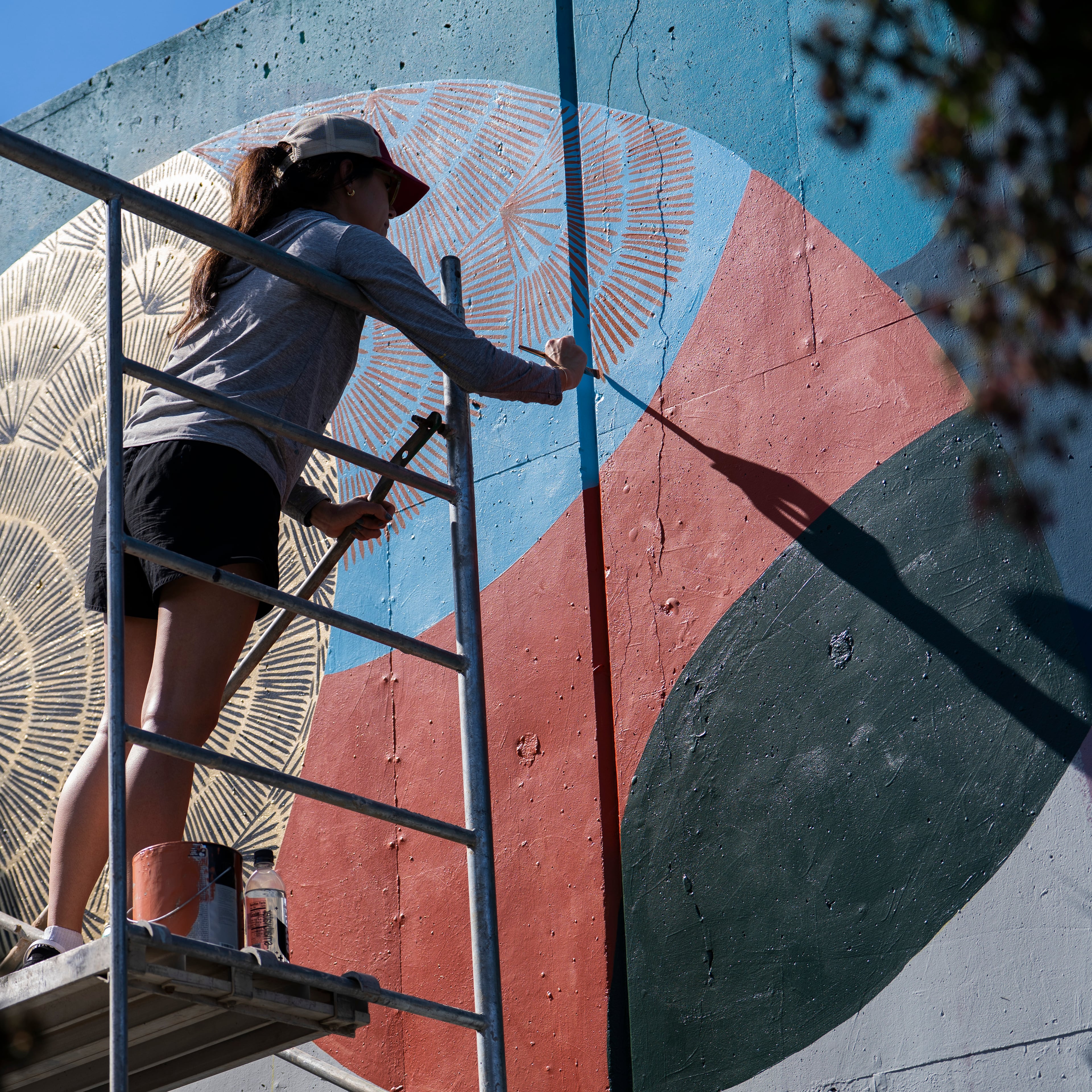
From there, Davenport steered a string of public art projects: a Georgia Council for the Arts grant to formalize “Tim Loves Tink,” graffiti residents kept lovingly restoring by hand whenever the city painted over it; a mural by artist Cheyenne Renee’s “50 in 50” project, dedicated to painting one small town in every state.
For years, Cornelia City Manager Donald Anderson had tried and failed to get a public mural project approved downtown. Perception was the obstacle.
“The biggest thing we had to do was educate the public,” he said, “because there’s a stigma that it’s graffiti.”
The city held workshops making the case for public art. “Once we got that one completed and the public saw what it was,” Anderson said, “it made it a whole lot easier.” Cornelia has since completed its third public mural downtown, with more planned.
Capturing history
Then came Brushstrokes of Change, the marquee project that brought Davenport’s design and history talents home. The project grew out of a 2024 conversation with Anderson about a state Vibrant Communities grant. Davenport’s team won a Georgia Council for the Arts grant in August 2025 for the 2026 fiscal year, with one real requirement: capture the history of the neighborhood itself, in the words of the people who’d lived it. The panels were completed by June and unveiled in August.

As part of Brushstrokes, Davenport held a series of town hall meetings in the neighborhood first, asking residents what they wanted to see. The centerpiece, Miss Sally’s face, anchors a dozen panels celebrating the people who shaped the community. On the reverse sides, Davenport painted what filled the neighborhood in the early to mid-1970s, when she was growing up: dominoes, paddle ball, jackstones, horseshoes, hopscotch, marbles, a reference to a pool that no longer exists. One panel is dedicated to the Soul Squad, a neighborhood softball team.
Though it was approved as a permanent installation, Davenport chuckles, “There is nothing permanent, except change.”
Anderson has lived in Cornelia for 20 years, and says the project taught him the town’s own history in real time. “As I would check the progress and ask who different people were,” he said, “I’d get the story behind them.”

Margaret Shirley-Myers has known Davenport since they were children on the Hill together. She supplied some of the old family photographs, pulled from her own relatives’ homes, that ended up woven into the panels. She also gave the introduction at the unveiling Aug. 8. “As an architect, Audrey learned that every strong structure begins with a solid foundation,” she told the crowd. “As an artist, she understands that communities are built the same way, upon history, relationships, and shared dreams.”
Cornelia has always had the largest Black population of any town in Habersham County. Today, of roughly 5,000 residents, fewer than 500 are Black.
“We exist,” Shirley-Myers said. “We have existed, and never should be forgotten.”
Always a builder
“Audrey is a shining light,” Shirley-Myers said. “She is down to earth. She does things from her heart.” She remembers her friend sketching on the couch since elementary school, and a hand-painted keepsake Davenport gave her before she left Cornelia at 15.
Davenport’s momentum with Cornelia didn’t stop at the panels. This year, when Georgia’s new Red Clay Creative Cohort grant opened applications with only days’ notice, she wrote the proposal, secured a $20,000 award, and recruited a 10-person creative team — before most people would have finished reading the announcement. “We got notice: Here’s this new grant, and applications are due in four days,” Anderson said. “Audrey made it happen.”
“I’ve always been a builder, I think,” Davenport said. “I believe that I can make a change in someone’s life,” she said. “And in doing so, it changes my life, too. I can change the world, so I try.”

AJC Her+Story is a series in The Atlanta Journal-Constitution highlighting women founders, creators, executives and professionals. It is about building a community. Know someone the AJC should feature in AJC Her+Story? Email us at herstory@ajc.com with your suggestions. Check out more of our AJC Her+Story coverage at AJC.com/herstory.
Audrey Davenport’s art history:
- Earned two architecture degrees from Savannah College of Art and Design, 2004-2009
- Served as interim executive director of Savannah’s Ralph Mark Gilbert Civil Rights Museum in Savannah
- Recruited to help organize a growing archive of local Black History with the Habersham County Historical Society. The project resulted in what is now part of a Digital Library of Georgia pilot program.
- Secured a Georgia Council for the Arts grant to formalize “Tim Loves Tink,” which graffiti artists lovingly restored by hand whenever the city painted over it
- Championed a mural by artist Cheyenne Renee’s “50 in 50” project, dedicated to painting one small town in every state
- Secured a Georgia Council for the Arts grant for “Brushstrokes of Change,” a 12-panel project celebrating the people who shaped the community of Cornelia
- Received a $20,000 award for the Red Clay Creative Cohort project, which offers training and funding to create meaningful arts projects with lasting community impact