How are football and soccer influencing each other? Just look at Atlanta.
Despite sharing the same name, no one would mistake an oblong pigskin for a hexagon-clad sphere.
Football and fútbol are built on different foundations, both as sports and as businesses. From the way they handle commercial breaks to the structure of their youth programs, there’s a reason why soccer is the world’s most popular sport while football is America’s most lucrative.
“Fútbol dominates globally, but American football dominates economically,” Charlie Stillitano, president of live sports and entertainment promoter TEG Sport North America, told a crowd at the Metro Atlanta Chamber on Monday.
NFL leaders have shown they’re focused on growing football’s appeal abroad, trying to make fans in countries without much tackle-sport competition. And both FIFA and MLS executives have said they envy the NFL’s economic dominance.

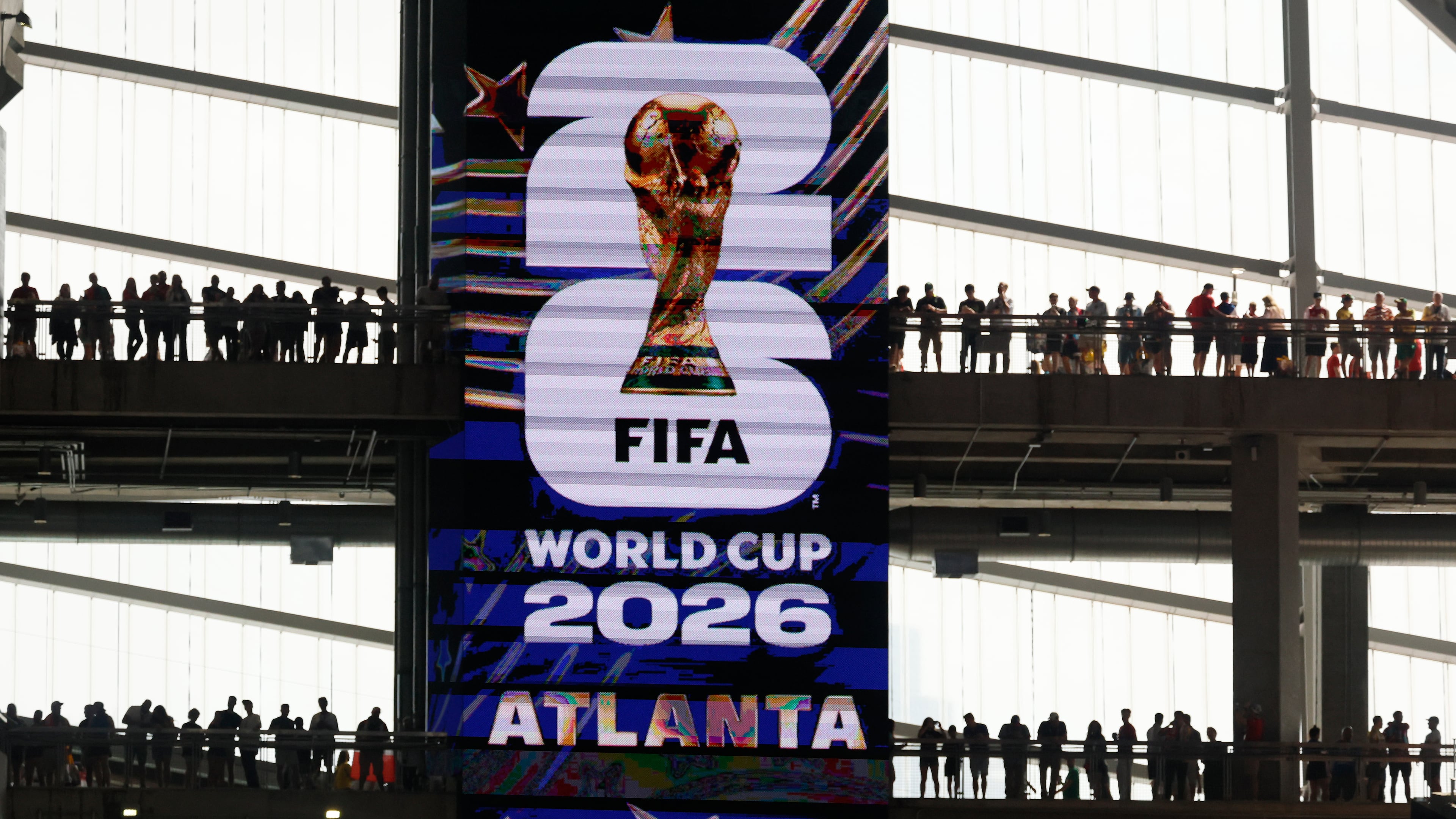
It’s led leaders of both sports to start to take cues from each other, influencing how football breaks into Europe and soccer expands its status stateside. Between the World Cup and Atlanta’s professional sports franchises, the city has become an early example of that evolution.
“The idea is show the sport, grow the sport and let the sport stand for what it is,” Rich McKay, CEO of AMB Sports and Entertainment, told the chamber audience Monday.
McKay, who effectively runs the parent company of the Atlanta Falcons and Atlanta United on behalf of Home Depot co-founder Arthur Blank, said football and soccer grow in popularity when audiences get to experience the world’s best for themselves.

Football’s expansion into Europe initially failed at launch. The NFL started with foreign NFL exhibition games in the mid-1980s, but audiences didn’t want America’s warmups, McKay said.
“The fans spoke back and said, ‘No, not for us. Bring us the real deal and play real games here that matter,’” he said.
Since 2007, the NFL has continually added more international games to its season, expanding to new countries along the way. The Atlanta Falcons will travel to Madrid in November, which Atlanta Mayor Andre Dickens said he’ll attend as part of efforts to grow business ties between the city and Spain.
Bolstered by blockbuster broadcasting contracts and ballooning stadium revenues, the average NFL franchise is worth more than $7 billion. That level of value is something the MLS has focused on since its inception three decades ago, said Jay Berhalter, the league’s executive vice president of business development.
MLS began with 10 teams each valued at $5 million a piece, and it was structured similarly to football. Both leagues have their worst-performing teams draft first, aiming to distribute talent more evenly.
“Our league is designed so that it’s supercompetitive between all the teams from top to bottom,” Berhalter said. “Fans, every year when they start the season, their team has a chance to win. It’s similar to the NFL.”
“Economically, we’re very far behind,” he continued. The average MLS team’s value is less than $1 billion. “But that construct has set us up for long-term success.”
MLS was founded because of the 1994 World Cup, which was the last time the U.S. played host to the tournament. Since it was announced in 2018 that America would once again host the World Cup, the MLS has added seven teams and nearly 20 stadiums and training facilities.

Investment is also being made in the U.S. by European teams, such as FC Barcelona. The team in early June opened a new American headquarters in Miami alongside a dedicated youth development program.
Bryan Bachner, managing director of FC Barcelona in the Americas, told chamber attendees that soccer’s growth relies on youth investment, which also means meeting young fans on platforms they use.
“The youth consume sport in a very, very different way,” he said. “… We’re pushing toward finding new ways to connect with the fan.”
FC Barcelona and music streaming service Spotify last year struck the largest sponsorship in soccer, an audio and stadium partnership worth more than $527 million. MLS similarly has a global deal with Apple, which Berhalter said is an effort to “make it as easy as possible for fans to find and consume our product.”
The NFL, in contrast, has its games spread across roughly 10 broadcast and streaming partners.
McKay said the American viewership of the average NFL game still dwarfs even World Cup matches. Team USA’s first match against Paraguay drew more than 27 million American viewers — a record for soccer, but that’s not much more than a regular-season NFL game.
McKay said that means soccer has a lot of room to grow, which he expects to happen as the World Cup, including the matches hosted in Atlanta, make a new generation of fans.

Blank is an example of this, McKay said. The billionaire philanthropist often says his love for soccer grew out of his kids playing the sport, leading him to help establish Atlanta United, invest in U.S. Soccer’s National Training Center in Fayetteville and bring a forthcoming NWSL franchise to the city.
“Arthur deserves a lot of credit because he did see it,” McKay said. “He saw what soccer would be and could be, and we still think it can be more.”