‘Art of Banksy: Without Limits,’ and without his permission, back in Atlanta
This story was originally published by ArtsATL.
There’s an inherent contradiction in taking artworks created by Banksy off the streets and placing them on display in a commercial gallery exhibition.
The anonymous British street artist has spent much of his life making art that appears in plain view, in places that were never intended to house art: on the sides of buildings, beneath bridges, on city streets, on the front lines of war-torn Horenka, Ukraine, in the Gaza Strip and in places where the boundaries between public and private space are deliberately blurred.
Banksy’s stenciled rats, children with balloons, riot police, smiley faces and masked figures are instantly recognizable symbols of resistance to centralized power, war, consumerism, the mundanity of everyday life and the machinery of commerce. Maintaining anonymity is key to the work shaping social discourse.
Further distancing himself from the commercial art world, Banksy, in 2018, posted on his official website, “Members of the public should be aware there has been a recent spate of Banksy exhibitions, none of which are consensual. They’ve been organized entirely without the artist’s knowledge or involvement. Please treat them accordingly.”
This is germane to Atlantans because a traveling exhibition, “The Art of Banksy: Without Limits,” is newly opened at Pullman Yards, raising questions about the message the work serves. What happens when art that’s made to disrupt public space is removed from that space and presented behind the controlled walls of a gallery? Banksy built his reputation on images that appeared unexpectedly on streets, where their surroundings, impermanence and accessibility were part of the experience.
Sorina Burlacu, the exhibition’s Romanian producer, offered her rationale for creating the exhibition via email.
“Banksy changed his artistic narrative when he decided to work with (serigraph) artists — when he asked them to put what he painted with stencils or on walls onto prints,” she wrote. “We have followed his approach with street art and included in the exhibition limited editions [sic] certified prints. We also work with international and local street artists who are painting in the same technique as Banksy on murals inside the gallery, creating a mix between prints and murals.”
The history behind ‘The Art of Banksy’ exhibition
“The Art of Banksy” exhibition began in 2016 when art collector and Banksy enthusiast Kemal Gürkaynak, managing director of Muse Marketing and Entertainment, unveiled the show in Istanbul. More exhibits followed throughout Europe and Australia.
Three years later, in 2019, Burlacu was invited to help with the show in Bucharest, where she lives. Since then, she has continued working on the exhibition and has become part of the creative team that brought it to Underground Atlanta in 2021 for its North American debut. “The Art of Banksy” has not been back to Atlanta since.
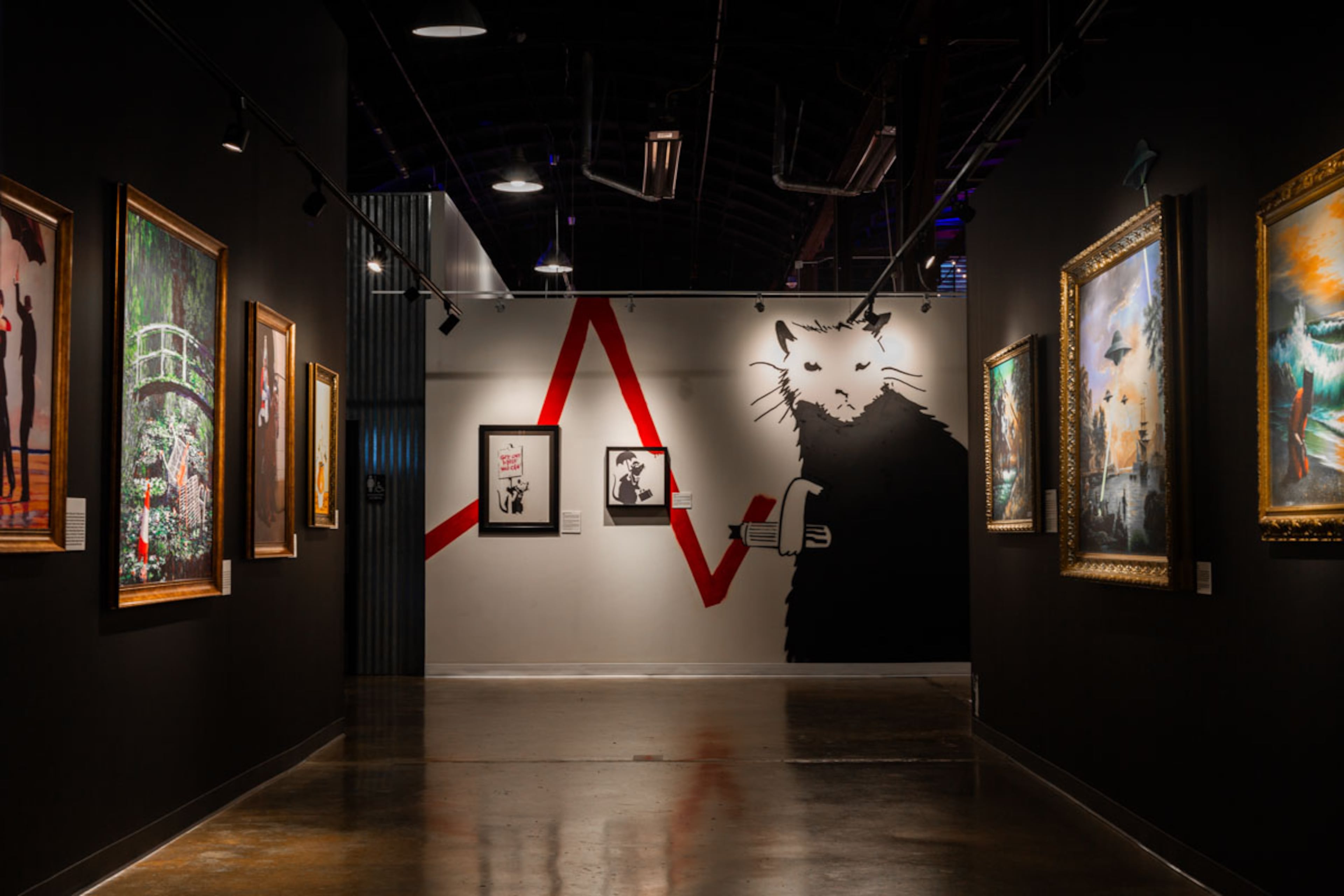
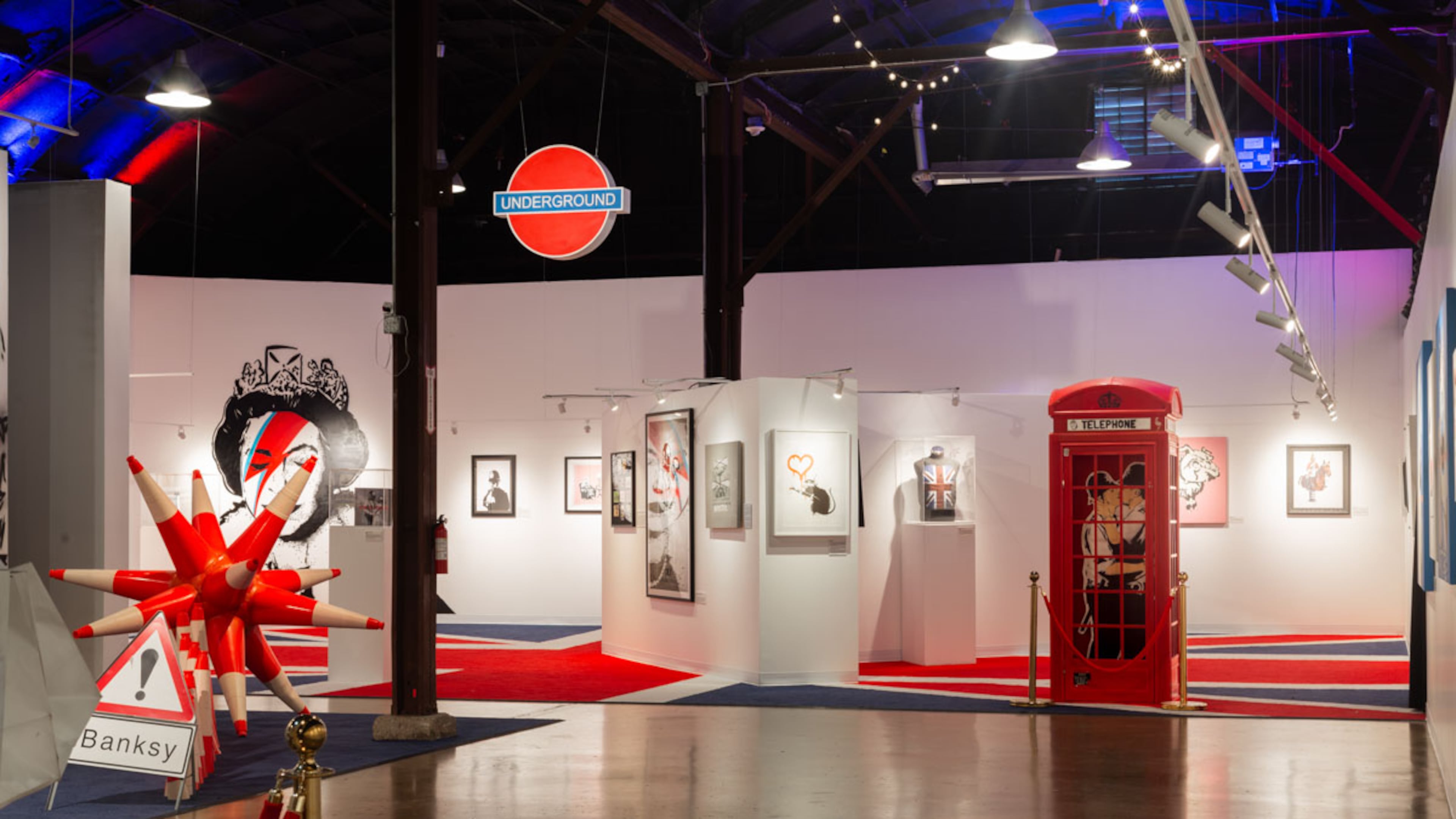
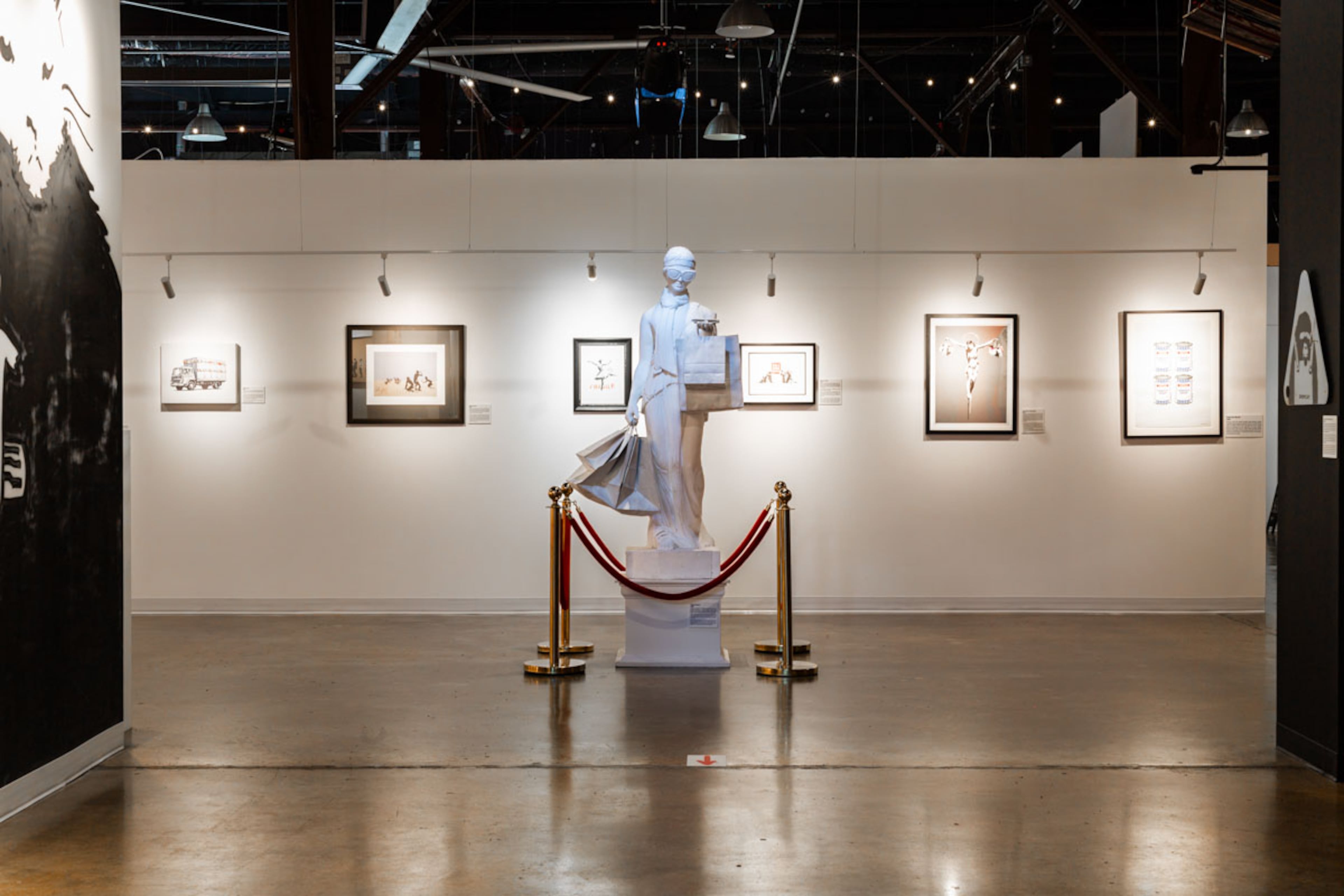
Organizers say this new iteration is substantially larger. The show features more than 200 pieces, 60 of which are verified Banksy originals. A holographic installation, an infinity room, a gallery devoted to Banksy’s short-lived “Dismaland” project and a collection of his collaborations with musicians, including Blur, Gorillaz, Massive Attack, Portishead and Wu-Tang Clan, have been added.
A portion of the proceeds from premium ticket upgrades and the stencil T-shirt station will be donated to maintain the Motor Vessel Louise Michel, an independent, high-speed rescue boat Banksy bought and painted in 2020 that operates in the Central Mediterranean to assist fleeing refugees.
The new show also includes an informative timeline. Banksy began his career in the early ’90s as a freehand spray-paint artist with the Bristol underground group DryBreadZ Crew. He painted his first major large-scale wall mural in 1997. Around 2000, he began using stencils for the quick turnaround time.
“Most artists have an obsession that defines their work. Monet had light; Hockney had color. I’ve got police response times,” the artist once said, according to an exhibition statement for a show at the Gallery of Modern Art in Glasgow.
Banksy’s true identity has never been revealed. Speculation abounds linking him to British street artist Robin Gunningham — a name that was changed after a New York City arrest in 2008. Banksy’s longtime lawyer, Mark Stephens, states that the artist’s anonymity protects his safety, privacy and freedom of expression. Indeed, it has become his brand.
Others have linked Banksy’s identity to Robert “3D” Del Naja, a vocalist with the Bristol-based trip-hop outfit Massive Attack. Still others believe that Banksy is a collective of artists and musicians working together under a singular moniker. In the meantime, Banksy uses an institution that goes by the name Pest Control Office to authenticate and to authorize his works.
Two Atlanta artists bring street-level craft to show
“What Banksy does is meant to be mysterious, and it is meant to have a political push — to keep an eye on what our governments are doing,” said Darrius “Spraykid” Ford, an Atlanta-based artist who is co-curating “The Art of Banksy: Without Limits” at Pullman Yards with fellow Atlanta artist Big Papito (Papa Fall), and an anonymous street artist from Mexico who operates under the name Desastre (serving as the show’s head curator).
“It’s a conversation starter, and the best way to do that is to keep it in the public,” Spraykid said. “But some of his greatest works were done in an era before everyone had a smartphone in their pocket, and before social media was even a thing. For younger eyes, a show like this keeps his name and his message alive and in a positive light. Let’s not forget, there’s a whole community out there that views what he does as vandalism.”
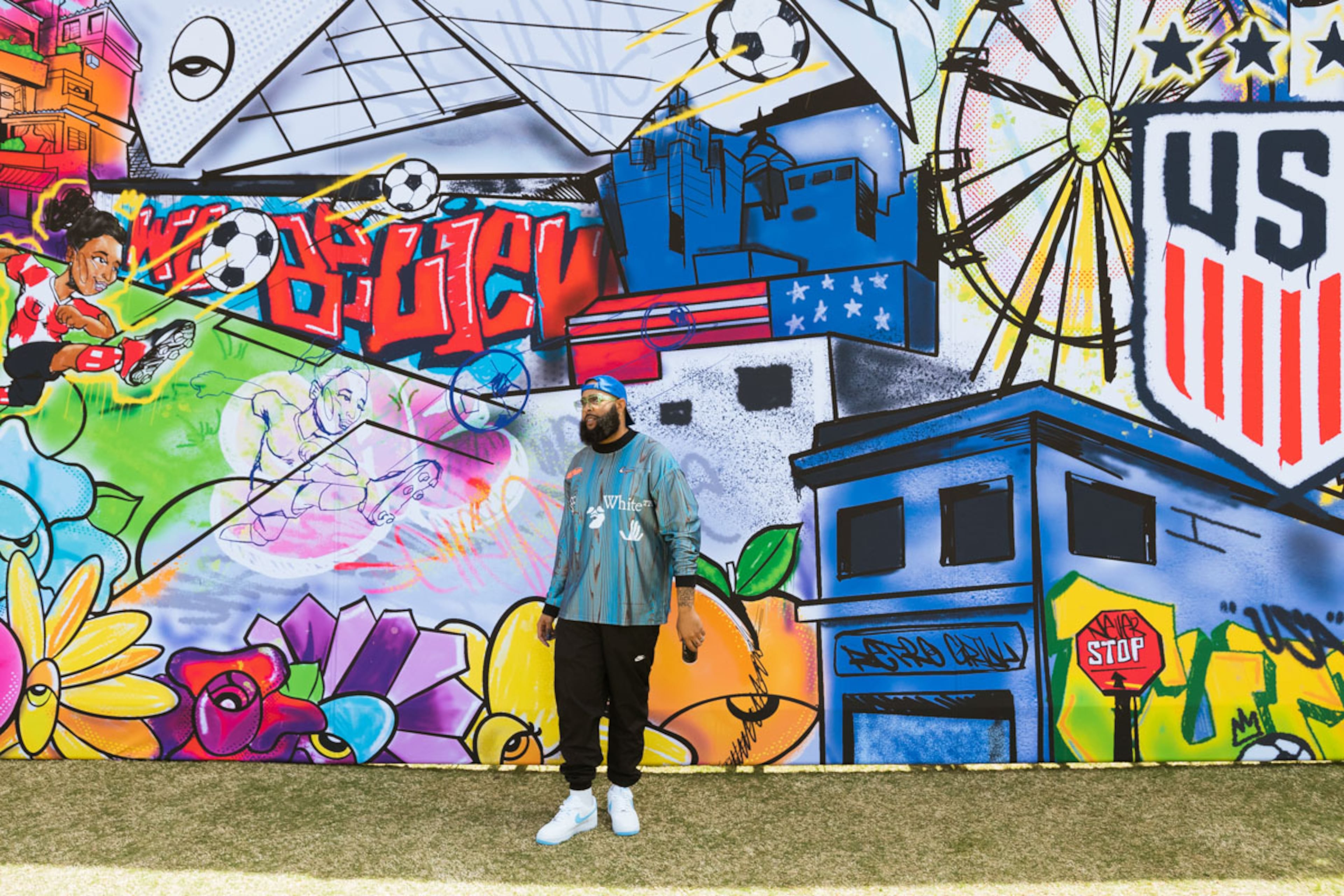
Spraykid’s own work leans into the abstract. His pieces have appeared in exhibitions at Gagosian in London and at Peabody Essex in Salem, Massachusetts. In Atlanta, Spraykid is perhaps best known as creative director of the apparel brand CEO Millionaires. In 2017, he designed clothing to accompany 2 Chainz’s Pink Trap House attraction on Howell Mill Road, as well as the Dabbing Santa sweaters that became a trend circa 2015.
Papito is a graphic designer and producer who earned his first official Recording Industry Association of America Gold record certification (500,000 equivalent units in the United States) for his production work on a song by hip-hop artists 42 Dugg & EST Gee. He also produced the 2 Chainz songs “Caymans,” “G6” (with Lil Wayne) and “Flow Switcha.” He now runs the clothing brand Burgundy.
To bring “The Art of Banksy: Without Limits” to life, Ford, Papito and Desastre used their street-level craft to prep the exhibition space, building out walls that echo the urban surfaces where Banksy’s works appear. They laid down base colors, cut and applied stencils, spray-painted, peeled away layers and went back in by hand to touch up the details. They even captured the drips, overspray and other subtle imperfections — the rough edges — that add to the distinctive look of Banksy’s work.
In the exhibition’s first iteration, Spraykid helped re-create Banksy’s “Queen Ziggy,” an image of Queen Elizabeth II with a Ziggy Stardust lightning bolt across her face; The “Rescue Vessel,” featuring a young girl in a life preserver; and “Swing Girl,” showing a young girl swinging from a parking sign.
One of Papito’s favorite Banksy works, he said, is “Flying Copper,” a winged police officer dressed in SWAT gear, holding an AK-47, with a yellow smiley face peeking out from inside his helmet.
“That one has really inspired me a lot,” he said. “It’s just such a crazy image, and the parallels of what it’s drawing upon mean a lot for me. I would love to paint the ‘Flying Copper.’ I’m gonna ask if I can paint that one.”
Papito also loves the stenciled “Gangster Rat.”
“The script, the letters, the screen, the spray paint drip — it’s just so crazy to me,” he said. “If I ever meet Banksy, I want to ask him what’s the real meaning behind the rat with its Run-D.M.C. chain and his little boom box.”
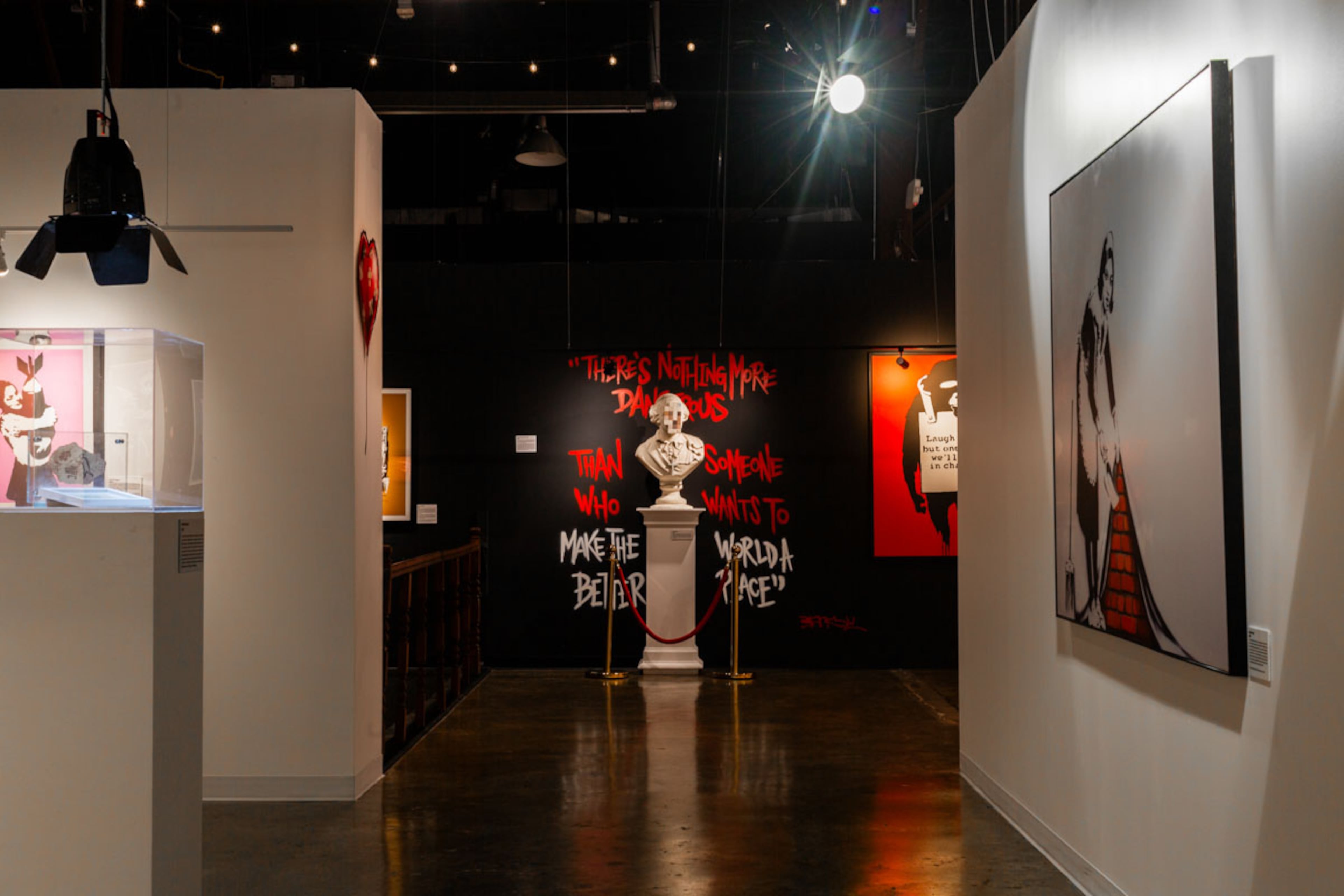
Can an indoor exhibit be a bridge to new audiences?
Banksy’s work is about challenging the systems that contain it, even as the images themselves have become objects of fascination, collection and commerce. For an artist whose work questions institutions, commerce and the commodification of art, the setup is difficult to ignore. A Banksy mural can be removed from a wall, reproduced as a print, certified, framed and sold for millions of dollars.
“The Art of Banksy: Without Limits” gathers these iterations of his work under one roof and puts them on display within a carefully constructed environment. The experience is far removed from the unexpected, unsanctioned encounters that gave the work its power in the first place.
While the exhibition cannot re-create the experience of stumbling upon a Banksy on a city street, where the work exists without permission or explanation, what it does offer is a concentrated look at how a body of work that once lived in the wild has traveled into the broader visual culture — and how its images continue to circulate, evolve and find new audiences.
IF YOU GO
“The Art of Banksy: Without Limits
Through January 2027 at Pullman Yards. Adult tickets start at $31. 225 Rogers St. NE, Atlanta. feverup.com.
::
Chad Radford is an Atlanta-based music journalist with 20 years of experience in writing, editing and podcasting.

MEET OUR PARTNER
ArtsATL (artsatl.org) is a nonprofit organization that plays a critical role in educating and informing audiences about metro Atlanta’s arts and culture. ArtsATL, founded in 2009, helps build a sustainable arts community contributing to the economic and cultural health of the city.