Bombs won’t determine Iran’s future. The people on the ground will.
From Atlanta, where Dr. Martin Luther King Jr.’s legacy remains part of our civic conscience, I often return to his warning: “Injustice anywhere is a threat to justice everywhere.”
Today, those words should direct our attention to Iran.
As attention once again turns to military confrontation with the Iranian regime, a larger question is being overlooked: Can war actually determine Iran’s political future?
There is an assumption that military strikes could bring down the Iranian regime and that democracy would somehow follow. History gives us reason to question that assumption. Bombing can weaken military capabilities and disrupt institutions of power, but it cannot create the political institutions that a democratic society requires.
There is another reality that deserves attention. Authoritarian governments can use war and national security emergencies to tighten their control at home. Amnesty International reported that Iranian authorities invoked “wartime conditions” amid intensified repression following the February attacks, with more than 6,000 people arbitrarily arrested.
For a regime confronting deep opposition at home, wartime conditions can provide another justification for restricting information, arresting opponents and suppressing dissent.
That is why war alone cannot determine Iran’s future.
Bombs can destroy military installations. They cannot establish the rule of law, create an independent judiciary, protect women’s rights, guarantee freedom of speech or organize free elections. Democracy cannot be dropped from the sky.
Younger generation is picking up the cause
The uprising of December 2025 and January 2026 demonstrated the depth of unrest inside Iran. Human Rights Watch and the Abdorrahman Boroumand Center reported that authorities executed at least 29 people arrested in connection with those protests between March 18 and the end of August. Scores more were reported to be at risk.
These actions raise a fundamental question about the rule of law. When protesters face arbitrary detention, grossly unfair proceedings and execution, Iran’s political future cannot be determined by those suppressing fundamental rights. It must ultimately be decided by the Iranian people through a free political process.
Organization inside Iran therefore matters.
The National Council of Resistance of Iran (NCRI) says resistance units affiliated with the People’s Mojahedin Organization of Iran (PMOI also known as MEK) operate as decentralized networks in cities across Iran despite enormous risks. Because clandestine activities are difficult to verify independently, specific claims about their operations should be attributed to NCRI. But the broader question remains important: if political change comes, who is organized to help sustain it?
Outside Iran, NCRI presents a political alternative and has published a plan for a transition. Under its proposal, a provisional government would serve for no more than six months, organize free elections for a national legislative and constituent assembly, and then transfer authority to elected representatives.
NCRI President-elect Maryam Rajavi’s 10-point plan calls for universal suffrage, political pluralism, freedom of expression, separation of religion and state, gender equality, abolition of the death penalty, an independent judiciary, minority rights and a nonnuclear Iran.
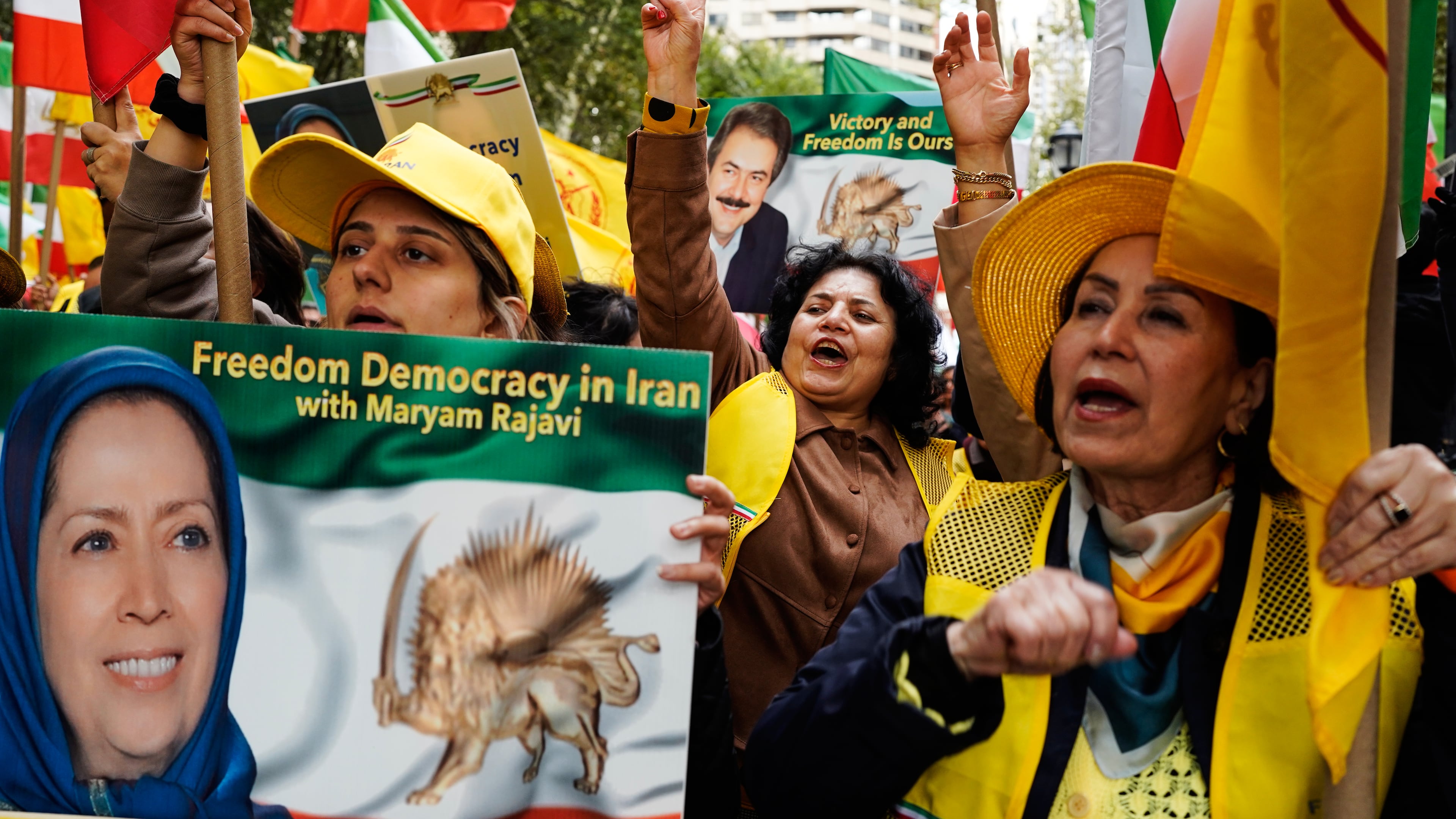
During the United Nations General Assembly, I traveled from Georgia to New York with members of our Iranian American community to attend gatherings outside the United Nations on Sept. 22 and 23. There, I witnessed thousands of Iranians, many of whom had traveled from communities across the United States and beyond, come together to demand a democratic future for their homeland. NCRI organizers also reported that thousands participated.
The size of the gathering mattered. Thousands of Iranians coming together in Manhattan in the middle of the workweek, and returning for a second consecutive weekday, represented a significant organizational effort.
But something else stayed with me after I returned to Georgia: the young generation. I saw young Iranians standing near the front, participating with energy and confidence, and speaking about the Iran they hope to inherit. This was not simply an older generation looking back at Iran’s history. I saw a new generation looking forward and demanding a voice in its future.

A credible regime transition process is key to legitimacy
The message expressed by many demonstrators was clear: no return to monarchy and no continuation of religious dictatorship. They called instead for a democratic republic in which Iranians can freely choose their representatives and determine their political future through the ballot box.
The Sept. 22 gathering was also marred by violence. According to the Organization of Iranian American Communities, Reza Ebrahimi, whom it identifies as an activist for Reza Pahlavi (son of the overthrown Shah), attacked a young MEK supporter, injuring his face and was subsequently arrested by police. For our community, the incident underscored why democratic principles must govern how Iranians treat one another today. No political allegiance can excuse violence against peaceful demonstrators. The right to oppose executions and advocate a democratic republic must be protected in New York just as it must be protected in Iran.
Fox News, reporting on the New York gathering, quoted NCRI U.S. Deputy Director Alireza Jafarzadeh: “The real change has to come from within.”
Even a leadership crisis at the top of the Iranian regime would not automatically produce democracy. Removing a leader is not the same as replacing a political system.
Something must come after dictatorship.
That requires people inside Iran, organization, political alternatives, a credible transition process and, ultimately, legitimacy granted by the Iranian people.
War can change the balance of power. But bombs cannot write a constitution, organize elections or decide who governs Iran.
From Atlanta, Dr. Martin Luther King Jr.’s message still resonates more than six decades later: “Injustice anywhere is a threat to justice everywhere.” His words remind us that we cannot ignore injustice simply because it occurs beyond our own borders. But standing with people facing repression also means respecting their right to determine their own future.
For Iran, that distinction is critical. The international community can stand against executions, repression and violations of fundamental rights. It can also recognize the National Council of Resistance of Iran as an organized democratic alternative with a stated transition plan, while recognizing that ultimate political authority must come from the Iranian people themselves. NCRI’s proposal calls for a provisional government whose central purpose is to organize free elections and transfer sovereignty to elected representatives of the Iranian people.
Recognition of an alternative should not mean deciding Iran’s government from abroad. It should mean recognizing the Iranian people’s right to organize, resist dictatorship and choose their future through free elections.
Iran’s future should not be decided by war, foreign powers, monarchy or religious dictatorship.
It should be decided by the Iranian people.
Batool Zamani is president of the Iranian American Community of Georgia.
Send letters to the editor of 250 words or fewer with your name, city or town and contact information to letters@ajc.com.