Gerrymandering tit-for-tat battles put partisanship above good governance
After the Virginia referendum April 21 that redrew their congressional districts, Democrats may be enjoying the Republican comeuppance this represents, but in reality, we are all impoverished by this game.
For those who have not been following the tit for tat. In June, President Donald Trump’s advisers started to insist that Texas conduct middecade redistricting to shore up the Republican majority in Congress and to try to stave off the typical midterm defeats for the party in charge. Texas jumped in with both feet and, in theory, wiped out five Democratic seats.
I say “in theory” because one great challenge to gerrymandering is that you have to assume that the coalition around which you build your gerrymander is static.
It now appears that Texas Republicans may have put a lot of swing voters in some of their “Republican” districts — in particular Hispanic voters who are increasingly furious about the Trump administration’s racist, jackbooted thug approach to immigration.
The Republicans targeted other states — Florida, Indiana, Louisiana, Missouri, North Carolina, Ohio and Utah — and while some did not go as planned, they appear to have picked up around eight to nine seats through these efforts, with as many as five more potential pickups if Florida aggressively redistricts.
Not surprisingly, Democratic state elected officials were motivated to counter with their own vicious gerrymanders. However, Democratic states had several problems.
Many Democrats, and I was one of them, had strongly supported nonpartisan redistricting. The idealistic reason was to try to restore some balance and good governance to our elections, on the theory that nonpartisan drawn districts would favor a more ideologically diverse mix of voters and therefore more moderate, less politically polarized candidates.
However, this was not without some self-interest.
In 2010, Republicans had swept in during an Obama-era midterm and ruthlessly gerrymandered states, so the thinking was that the good governance arguments around nonpartisan redistricting could be leveraged to try to break the Republican hold and at least bring some long-term parity to the elections.
Former AG’s nonpartisan strategy criticized

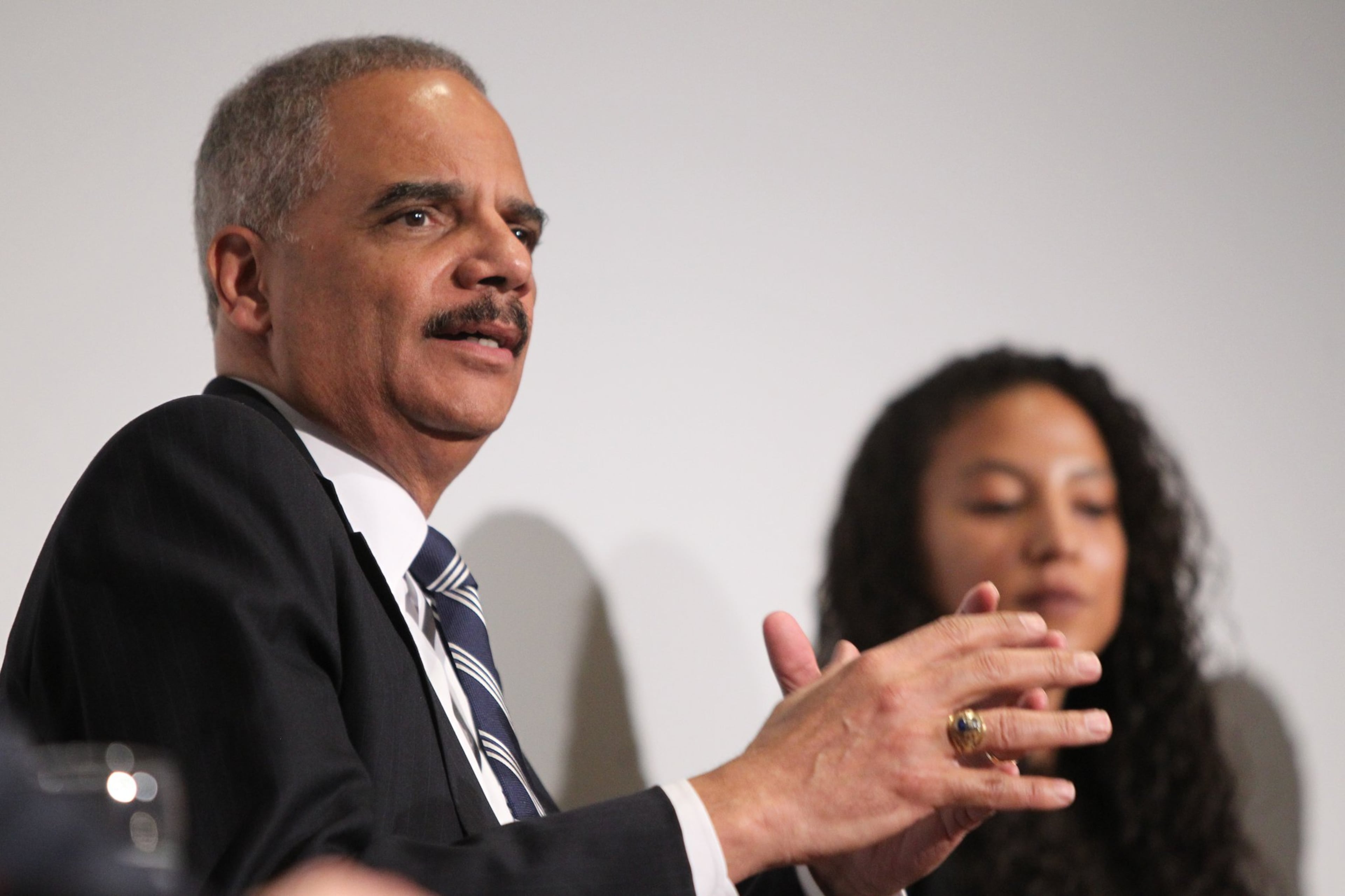
Former Attorney General Eric Holder with his “All on the Line” campaign traveled the country promoting nonpartisan redistricting, with a particular focus on swing states, as part of the Democratic strategy to prepare for the 2022 redistricting fights.
Many Democrats were not persuaded. One of my favorite stories about the late Georgia U.S. Rep. David Scott occurred during a meeting I had with him and others about Georgia’s 2022 redistricting.
Scott was firmly in the camp that redistricting was about power and, at one point, he lost his temper and berated Holder and his allies for their strategy on redistricting, referring to them as the “the whore of Babylon” — a reference from the Bible’s New Testament Book of Revelation as a metaphor for a false, malevolent or corrupt worldview.
Scott did have a point. Republicans were unpersuaded about the virtues of nonpartisan commissions, which meant Democratic-controlled states were far more likely to pass these provisions, creating a form of unilateral disarmament.
In 2022, 41% of U.S. House districts were in GOP-controlled states, and only 11% of districts were in states controlled solely by Democrats. 19% were controlled by independent commissions, and 21% were drawn by the courts.
Also, in several critical cases, the courts intervened and drew the districts when the state’s nonpartisan mechanism deadlocked. This happened in both Virginia and New York.
This focus on good governance is why both California and Virginia had to put their maps through a highly fraught and expensive referendum process. In California, these new maps passed by wide margins, netting Democrats five new seats, but in Virginia it barely squeaked by in large part because Democratic leaders such as Gov. Abigail Spanberger and Obama had to publicly walk back their prior statements in support of nonpartisan redistricting.
The privileging of these nonpartisan processes are also why the courts intervened to prevent the New York Legislature from wiping Republicans off the map in middecade redistricting.
Swing districts diminish with redistricting games
Which brings us to our current hurting stalemate: the Virginia referendum that passed April 21 will most likely wipe out around four Republican-favoring districts, bringing the Democrats to parity for the moment.
Now there is likely one more twist in the road as the U.S. Supreme Court is considering wiping out minority opportunity districts, or voting rights districts. While I know Republicans say they are supporting this and Democrats do not, be wary of unanticipated consequences. For instance, one reason that California and Illinois did not gerrymander as aggressively as they could have was because they were concerned about voting rights districts.
Does this matter? Yes — for all of us, because while Holder and the advocates for fair districts were probably wrong on the power politics, they are right on the implications that this represents a hollowing out of the moderate center.
When I first ran for Congress in 2018, there were around 30 “toss-up” or swing seats and 45 marginal ones that only leaned D or R. In 2026, after the Virginia gerrymander, there are around 16 toss-up seats and perhaps 16 marginal ones.
When I was in Congress, the key members of the bipartisan Problem Solvers Caucus, the moderate Blue Dog Caucus as well as the group of Republicans willing to stand up to Trump almost all came from swing districts.
Now almost all of them are gone or are leaving, on both sides of the aisle, and this country is most certainly going to be the worse for it.
Carolyn Bourdeaux is a former Democratic member of Congress from Georgia’s 7th District. She is a contributor to the AJC.