King Charles III and America’s curious love affair with the British monarchy
I am an Englishman who has lived most of his adult life in America. I’ve always been astonished at how much Americans love the British Royal Family.
What outpourings of love and grief met the death of Princess Diana in 1997. And what a surge of pure delight greeted Queen Elizabeth II when she visited in 2007.
But surely the Americans fought a revolutionary war to get away from kings and queens. Think of the American families whose loved ones died fighting the Redcoats. How horrified would they be to learn that their descendants eagerly awaited each royal visit?
The Declaration of Independence condemns the King of England for his conduct as the Revolution began. “He is at this time transporting large armies of foreign mercenaries to complete the works of death, desolation and tyranny,” wrote Thomas Jefferson, “already begun with circumstances of cruelty and perfidy scarcely paralleled in the most barbarous ages, and totally unworthy the head of a civilized nation.”
No wonder he thought America was justified in severing all ties.
Compare the monarchy to a democratic republic

As we approach the 250th anniversary of that declaration, however, King Charles III is coming to visit America April 27-30.
President Donald Trump may not be the consummate diplomat, but I doubt he’ll reproach the current king for the bloodshed of the 1770s and 1780s. The mood promises to be one of celebration.
Think how much less exciting to most Americans a visit by Prime Minister Keir Starmer would be, not to mention how much less harmonious the conversation.
That’s because the British system has one person working as head of government and another working as head of state. One is chosen democratically, the other by heredity.
This separation of roles, already in place during the 1770s, contrasts with the American system of making the elected president head of state and head of government.
Which is the better system? One obvious drawback to the American system is that it gives even energetic presidents more work than they can possibly manage. Another drawback is that every presidential election divides the population. As a result, the American head of state is always a man against whom a large part of the electorate voted. He’s often widely disliked or even hated.
By contrast, Britain’s constitutional monarchy represents continuity. Prime ministers come and go but the monarch stays in place. Second, it’s not democratic, so the monarch never has to run for office, never has to make feverish and unrealistic promises to the electorate, and never had to push and struggle his way to the top. The monarch is completely unlike the people who win elections and who thrive in the argumentative and turbulent world of electoral politics. Even if he is a trifle dull, he represents the nation, its continuity, and its stability.
Only one president received universal acclaim
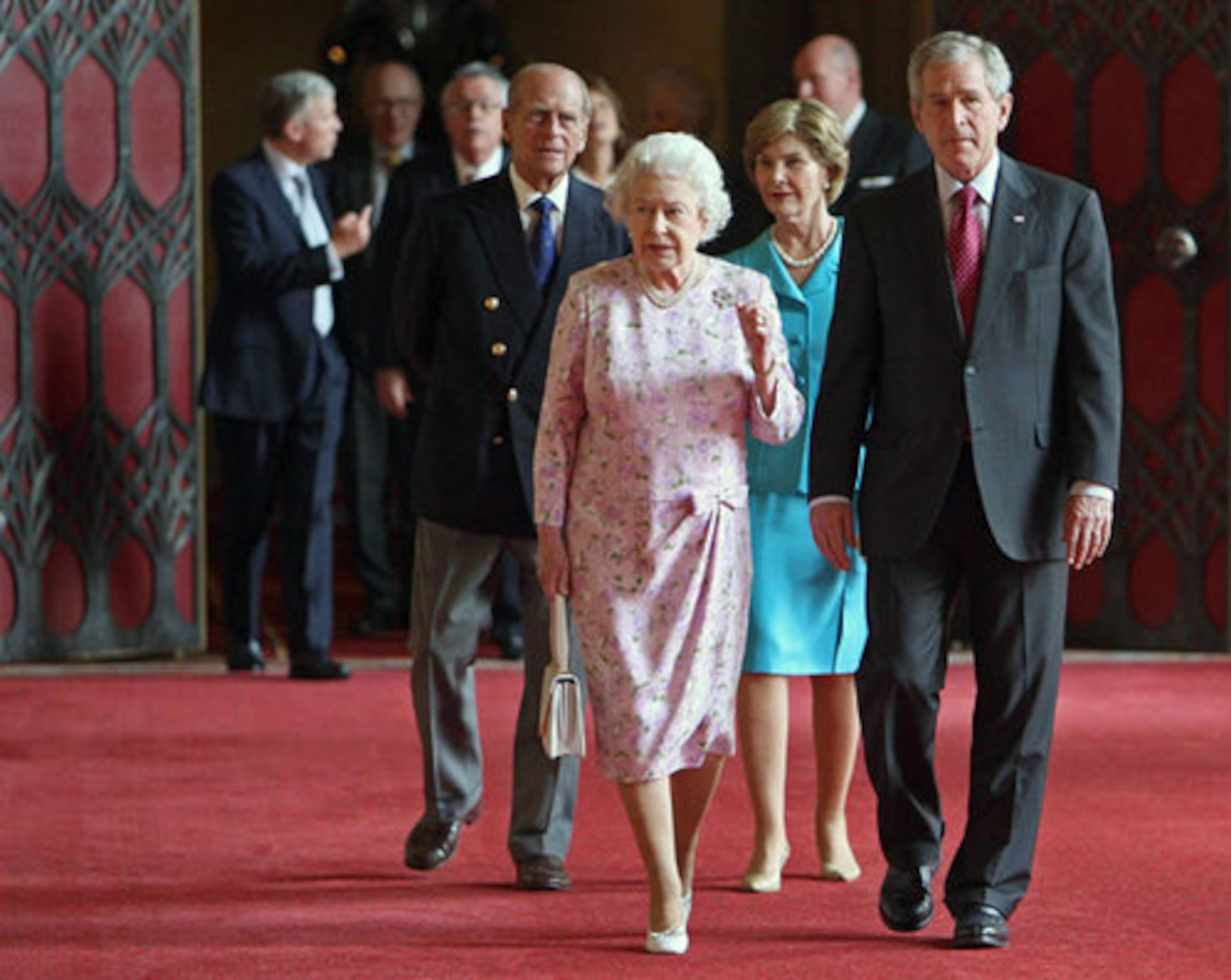
Is democracy always best? Some of the Founding Fathers recognized the advantages of the British system. Alexander Hamilton sat quietly for the first few weeks of the Constitutional Convention in 1787, but on June 18 he rose to give a speech that lasted nearly all day. He argued that America should model its new government on the British system, electing a president but then leaving him in office for the rest of his life like a king. James Madison, who drafted the Constitution, also regarded too much democracy as dangerous, not liberating, and looked for ways to limit its extent and influence. Senators should be chosen indirectly; federal judges should serve for life.
It’s odd that, with the passage of time, we’ve come to think of the Constitution as America’s great pro-democracy document. The founders knew that democracy keeps the political temperature high all the time — often too high — and sometimes elects scoundrels. What they wanted was government by virtuous men that promoted calm and continuity.
Has any American president been greeted with as much warmth and devotion as the visiting kings and queens of England? Yes: the very first one, George Washington. He was acclaimed as president and ran unopposed. None of his successors shared that acclaim. Others enjoyed euphoric moments but all of them, including Abraham Lincoln, Theodore Roosevelt, and Franklin Delano Roosevelt, were as bitterly hated by some parts of the population as they were loved by others.
I’m not arguing that the United States should become a monarchy. And I know that the crowds who will turn out to see Charles and Camilla are not hoping for that outcome. Still, it’s striking to see such a disparity in attitudes, apparently spontaneous, and to realize that there’s something about a king that millions of Americans find irresistible.
Dr. Patrick Allitt is a professor of history at Emory University. He was born and raised in England and was an undergraduate at Oxford and a graduate student at the University of California, Berkeley, where he earned a Ph.D. in American History. He is the author of seven books and has been a professor at Emory University in Atlanta since 1988. In the spring semester of 2026 he has been teaching an undergraduate course on the history of the American Revolution.