I was arrested for speaking up in Georgia. Today, I’m holding my head high.

Eight years ago, I was put in handcuffs and taken out of the Georgia Capitol for standing with my constituents on Nov. 13, 2018.
Before I became the congresswoman for Georgia’s “Fighting Fifth” congressional district, I served as a Georgia state senator representing the 39th District, which included Atlanta, College Park, East Point, South Fulton and Union City.
I showed up that morning to do my job as the “people’s state senator.” The Senate had adjourned, and as I was waiting for the House to convene I noticed a large police presence gathering.
I heard glass break and a commotion on the floor below me in the rotunda, so I went downstairs. I was immediately greeted by people who had been part of the protest. They told me, “They just threw an older lady to the ground, and they’re arresting people.”
The protesters were exercising their First Amendment constitutional rights. Amid mounting concerns of voter suppression, they were demanding that every vote be counted in the still-undecided governor’s race between my friend and colleague Stacey Abrams and then-Secretary of State Brian Kemp.
John Lewis inspired us to make ‘good trouble’

I went downstairs to make sure my constituents were safe and their voices were heard. I saw one of my constituents standing among the crowd, I stood beside her. I wanted her to know that she was not alone. That she was seen, heard and supported.
Moments later, officers pushed my arm behind my back, placed me in zip-tie restraints and arrested me. Despite knowing I was a state senator there to do the business of the state during the special session, they took me out of the Capitol with my hands zip tied behind my back and transported me to the Fulton County Jail. I was held for hours without even knowing why I was being detained.
While sitting alongside the group with whom I was arrested, we finally learned that everyone there, including me, had received a charge of disrupting the General Assembly. But apparently, I was special, and someone wanted to make a point with me. I received two charges: disrupting the General Assembly and obstruction.
As I was arrested, escorted out of the Capitol, hands behind my back and transported to the Fulton County Jail, I kept thinking about my mentor and friend, the legendary Congressman John Lewis.

He taught us what it meant to make “good trouble, necessary trouble.” I didn’t know it then, but three years later, I would follow in his footsteps and carry his legacy in the very halls of Congress.
That day in the Capitol didn’t end my fight for voting rights. In fact, it strengthened my resolve.
Voting rights legislation has broad support
Since my election to Congress, I’ve made protecting the right to vote and ensuring every eligible voter has access to the ballot a priority in my work.
I’ve introduced one of the most comprehensive voting rights legislative packages in congressional history. The package has broad bicameral support, with multiple senators introducing companion bills.
Legislation included in the package would fully fund election administration around the country, reduce long lines that deter people from voting, guarantee workers time off to vote, improve how election mail is delivered and processed, make voting more accessible for people experiencing homelessness, provide election materials in more languages, and help people understand how to register and protect their voting rights when they move.
I’ve also joined another mentor and predecessor in the “Fighting Fifth,” Ambassador Andrew Young, in calling for our state’s district lines not to be redrawn in the aftermath of the U.S. Supreme Court’s Louisiana v. Callais decision.
When President Donald Trump threatened to send U.S. Immigration and Customs Enforcement to the polls, I introduced a congressional resolution to reinforce the ban on federal agents at polling places. And I was at the Fulton County Elections Office after the FBI raided it, demanding answers and accountability.
Over the last two years, I have reminded people, “This is our Civil Rights Movement.” If you’ve ever wondered what you would have done during the Civil Rights Movement, this was your time to find out. If you care about labor rights, climate justice, the economy, immigration or reproductive freedom, you care about voting rights. Our ability to make our voices heard at the ballot box is connected to every issue that affects our lives.
Gov.-elect Bottoms’ victory inspires young people

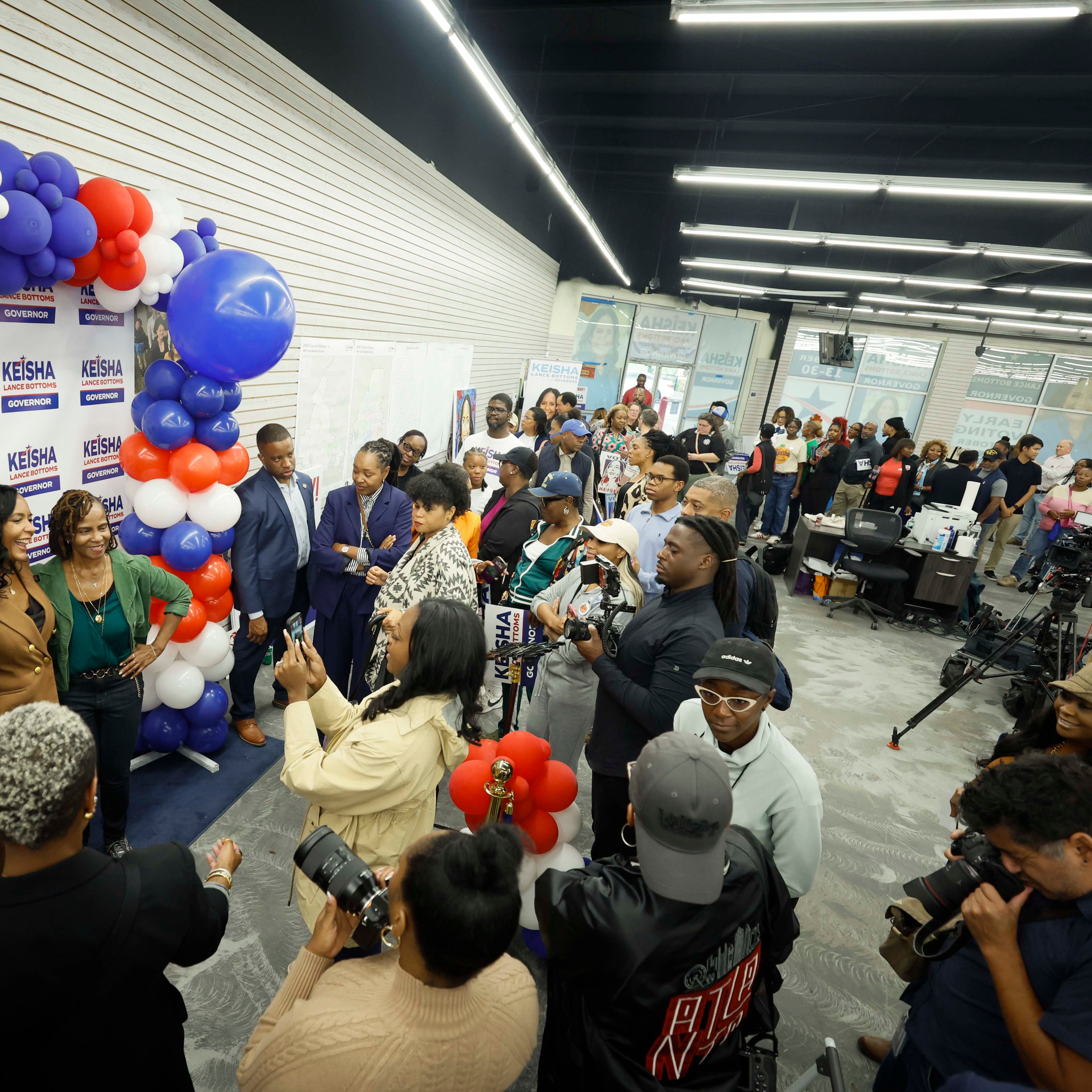
On Nov. 3, Georgia voters showed us exactly what they would have done during the Civil Rights Movement and made their voices heard in a historic way. We elected Keisha Lance Bottoms as the first Black female governor in our nation’s history.
It was the culmination of so much work during our lifetimes — and the lifetimes of those who came before us. I think about Stacey Abrams. I think about the groups that have organized for decades in Georgia. I think about watching former state lawmaker and Atlanta city official Rashad Taylor as a fellow young Democrat, not knowing that one day he’d lead the campaign for the first Black woman governor of our state and country.
When I first ran for the Georgia state Senate, a well-meaning supporter told me to put “Nikke” on my campaign signs. They thought I’d get more votes if people couldn’t tell from my name that I was a Black woman. I ran as Nikema.
Years later, my son, Carter, witnessed Georgia elect Keisha Lance Bottoms, a Black woman who went to Ralph J. Bunche Middle School, the same school he attends. I want Carter and his classmates to know they can put their own names on a campaign sign someday and ask the people of Georgia to trust them to lead. That’s part of what made the words I heard on election night mean so much to me — Gov.-elect Keisha Lance Bottoms.
On election night, as I gathered with family, friends and staff, someone in the room exclaimed, “My governor’s name is Keisha, my congresswoman is Nikema and my mayor is Dre!”
Eight years ago, I was led out of the Georgia Capitol, hands zip tied behind my back for demanding that every vote be counted for my friend and democracy warrior, Stacey Abrams. I now get to walk back through those doors with my head held high to work with our next governor, Keisha Lance Bottoms.
I think about the Georgians who stood with me that day and the voters who made this moment possible. I’ll carry them with me every time I walk into the Gold Dome and the U.S. Capitol. I’m ready to work alongside our new governor to protect their right to vote and deliver for the people of Georgia’s “Fighting Fifth.”
Congresswoman Nikema Williams, D-Atlanta, represents District 5 in the U.S. House of Representatives.
Send letters to the editor of 250 words or fewer with your name, city or town and contact information to letters@ajc.com.
The opinions expressed are those of the writer and do not necessarily reflect the views of The Atlanta Journal-Constitution.