Atlanta united after The Temple bombing. I worry about our Jewish teens today.

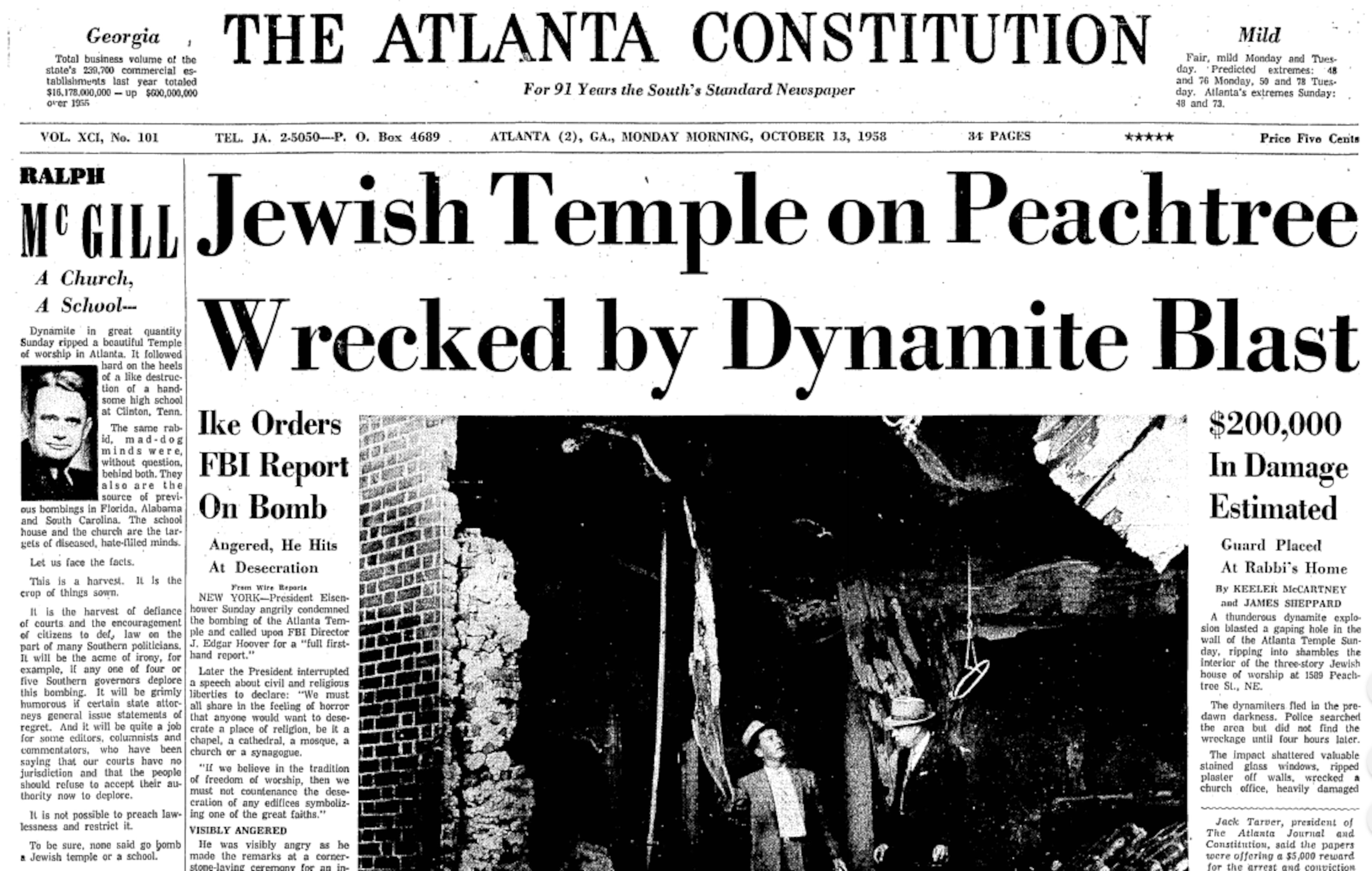
On Oct. 12, 1958, 50 sticks of dynamite exploded at The Temple on Peachtree Street.
The next morning, The Atlanta Constitution editor Ralph McGill wrote a column that would become part of this city’s history.
He called it “A Church, A School.”
McGill connected the bombing of an Atlanta synagogue with the bombing of a high school in Clinton, Tennessee.

His point was that neither act came from nowhere. Hate has a progression. Words become acceptable. Ideas that once shocked us become familiar. And eventually someone acts on them.
Nearly 70 years later, I keep coming back to McGill’s title.
Because I work in Atlanta schools.
Antisemitism has been normalized for teens

For more than 30 years, I have worked with Jewish teenagers. Today, much of that work happens inside public high schools across metro Atlanta.
And I have never seen what I am seeing now.
It isn’t only the rise in antisemitism that concerns me. It is what living with it every day is doing to our teenagers.
I meet students who tell me they have never experienced antisemitism.
Then we talk.
They tell me about hearing that Jews control the media. They hear lies about Israel repeated so often they are accepted as unquestionable facts. They are expected to explain or defend the actions of a government thousands of miles away simply because they are Jewish.
And often they don’t call any of this antisemitism.
They call it school.
That may be what worries me most.
When something happens often enough, teenagers adjust. What would once have been shocking becomes uncomfortable. What was uncomfortable becomes ordinary. And eventually ordinary becomes something you learn to live with.
Then come the small decisions.
Do I wear my Star of David today?
Do I tell my classmates I missed school for a Jewish holiday?
Do I speak up when someone says something about Jews that isn’t true?

Do I tell people I am going to the Jewish club?
Or do I make myself a little less Jewish at school because life is easier that way?
No newspaper will cover those decisions.
But I see them.
I have even had students ask whether we could remove the word “Jewish” from the name Jewish Student Union because they were worried about how other students would react to it.

Teenagers shouldn’t be blamed for government policy
A teenager should not have to calculate the social cost of being visibly Jewish before walking into algebra.
And yet, there is another part of this story.
Our teens keep showing up.
Since Oct. 7, 2023, students across the country have asked to start hundreds of new Jewish Student Union clubs.
The significance of that can be easy to miss.
These aren’t adults opening Jewish institutions for teenagers.
The teenagers are doing it themselves.
They reach out to us because they want a Jewish community in their school. They fill out the paperwork. They ask for a room. Then they put the word “Jewish” on the door.

At the very moment when there is more pressure to hide, they are choosing to be seen.
This Sunday through Tuesday, some of those leaders from Atlanta’s Jewish Student Union clubs will join Jewish teens from across the country in Stamford, Connecticut, for the JSU Presidents Conference. They will spend those days connecting with one another, strengthening their Jewish identity and preparing to lead in their schools.
They are not waiting for someone else to create the Jewish future they want to see. They are building it themselves.
Atlanta should notice that.
Not because everyone needs to agree about Israel. They won’t.
Not because Jewish students should be shielded from difficult political conversations. They shouldn’t.
But there is an enormous difference between debating a country’s policies and making a Jewish teenager responsible for them.
I am concerned for and inspired by our youth
A 16-year-old in an Atlanta public school is not a government spokesperson.
She is a kid trying to get through chemistry.
And she deserves the same thing every other student deserves: the ability to walk into school without deciding which parts of herself are safe to bring inside.
That responsibility does not belong only to Jewish parents or Jewish organizations.
It belongs to all of us.
It belongs to the principal who takes a student’s concern seriously.
The teacher who is willing to open a classroom to the Jewish club.
The parent who teaches a child that the Jewish student sitting next to them is a classmate, not a representative of a foreign country.
The student who hears a conspiracy theory about Jews and says, simply, “That’s not true.”
Most of the time, standing up to antisemitism will not look heroic.
It will look like that.
In 1958, Atlanta woke up to the shattered entrance of a synagogue.
The Temple was rebuilt. It still stands on Peachtree Street.
Today, the question facing Atlanta is quieter.
It is being asked in bedrooms across this city as Jewish teenagers get dressed for school.
A student stands in front of a mirror, holds a Star of David in her hand and makes a decision.
Do I put it on?

Nearly 70 years ago, Ralph McGill wrote about a church and a school.
I spend my days in the schools.
After three decades of doing this work, I have never been more concerned about what our teenagers are hearing.
But I have also never been more inspired by what they are choosing.
Again and again, they put on the necklace.
They walk through the doors.
They show up.
Nearly 70 years ago, Atlanta had to decide what kind of city it wanted to be.
Our teenagers should never have to wonder whether that answer includes them.
Rabbi Chaim Neiditch is a nationally recognized leader in Jewish teen engagement who has spent more than three decades working directly with tens of thousands of Jewish teens. As executive director of Jewish Student Union Atlanta, he works with students in public and private high schools across metro Atlanta, helping them strengthen their Jewish identity and confront rising antisemitism.
Send letters to the editor of 250 words or fewer with your name, city or town and contact information to letters@ajc.com.
The opinions expressed are those of the writer and do not necessarily reflect the views of The Atlanta Journal-Constitution.