Subtlety not strong point of civil rights drama
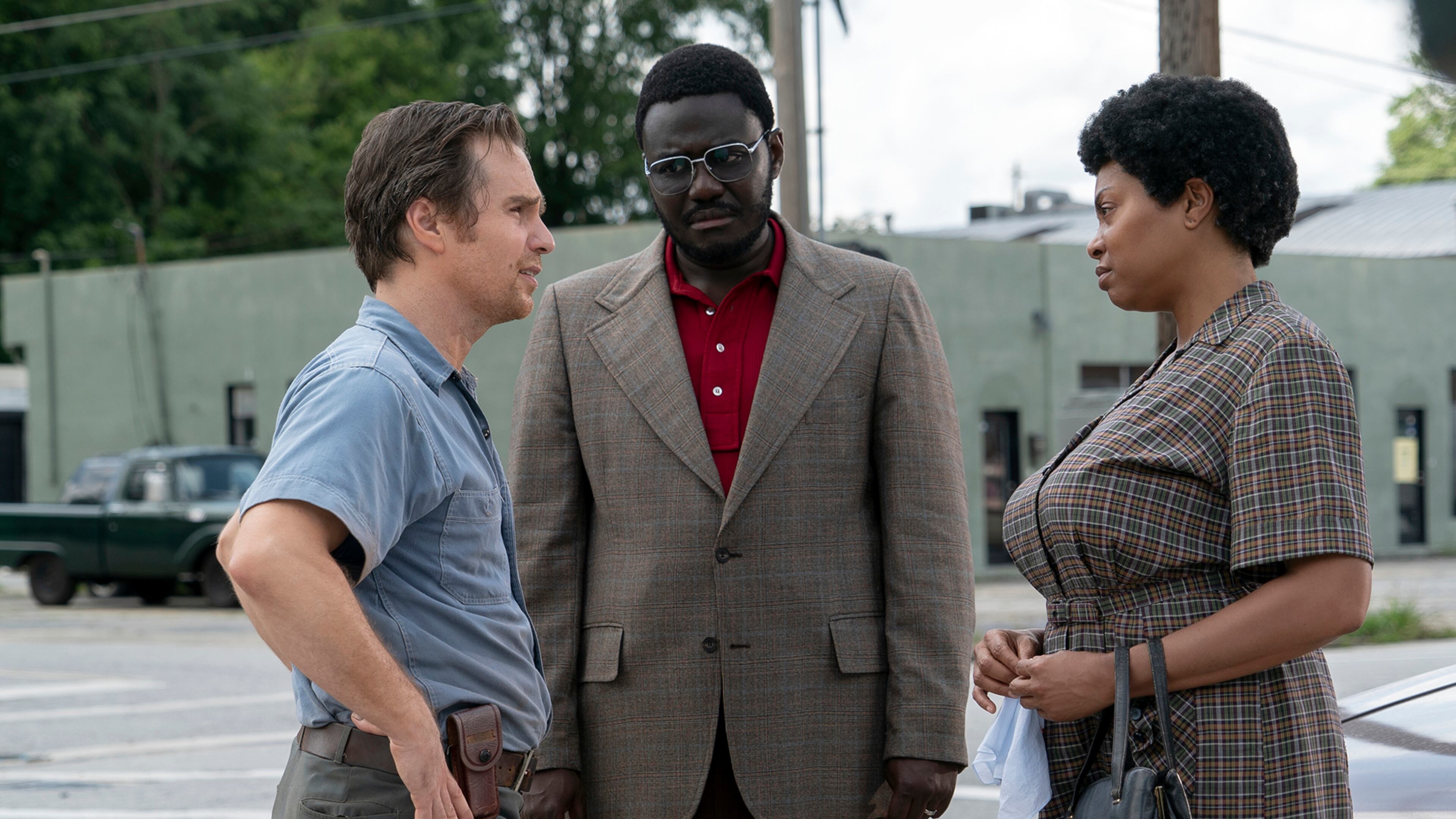
In a time and place where blacks and whites rarely cooperate, a Ku Klux Klan leader agrees to help lead public meetings on the subject of possible school desegregation. The process transforms his life — and, by the way, everyone else’s — in “The Best of Enemies.”
Yes, this is another semi-historical civil rights drama about a white guy. Writer-director Robin Bissell trains the spotlight on C.P. Ellis (Sam Rockwell), a gas station owner and KKK “Exalted Cyclops” who liberalizes his outlook while collaborating with African American community activist Ann Atwater (Taraji P. Henson) in Durham, North Carolina, in 1971.
As in “Green Book,” the emphasis is defensible in terms of dramatic development: Ellis, not Atwater, is the one who changes as “The Best of Enemies” skillfully follows the uplift-movie formula. But that doesn’t make its scenario any less irksome.
The movie’s Ellis is a mean-spirited, gun-toting racist with only one sensitive spot: his children. He comes to understand African American parents’ fears for their kids after Atwater points out that his are vulnerable, too. Ellis and his wife (Anne Heche) are particularly anguished about their son who has Down syndrome.
After a fire damages an all-black school, Durham leaders ponder allowing the students to attend an all-white school. To settle the issue, the city council reluctantly agrees to a series of parleys led by Atwater, Ellis and a facilitator. At the conference’s end, a panel of six blacks and six whites will vote on desegregation. Eight “ayes” are needed for passage, so at least two whites must vote for the controversial change.
(In reality, of course, integration was necessitated by Brown v. Board of Education, not smoke damage.)
The two youngest white members of the group appear inclined to ditch school segregation, but perhaps one of them can be intimidated. That would leave the deciding vote to Ellis, whose ultimate decision won’t surprise the Hollywood-savvy viewer — even though the movie’s melodramatically protracted climax plays his announcement as if it’s a shocker.
Bissell, executive producer of “The Hunger Games,” has crafted an effective mainstream entertainment, topped with a pleasing dollop of righteousness. But subtlety is not in his repertoire. The mostly short scenes are often overpowered by pop songs and Henson’s performance is so broad it verges on farcical. “The Best of Enemies” is perhaps the first account of the United States’s traumatic racial history that could be adapted into a sitcom.
MOVIE REVIEW
“The Best of Enemies”
Grade: C+
Starring Taraji P. Henson and Sam Rockwell. Directed by Robin Bissell.
Rated PG-13 for mature thematic material, racial epithets, some violence and a suggestive reference. Check listings for theaters. 2 hours, 12 minutes.
Bottom line: Another semi-historical civil rights film about a white guy

