2 of Georgia’s oldest newspapers acquired, will increase local coverage
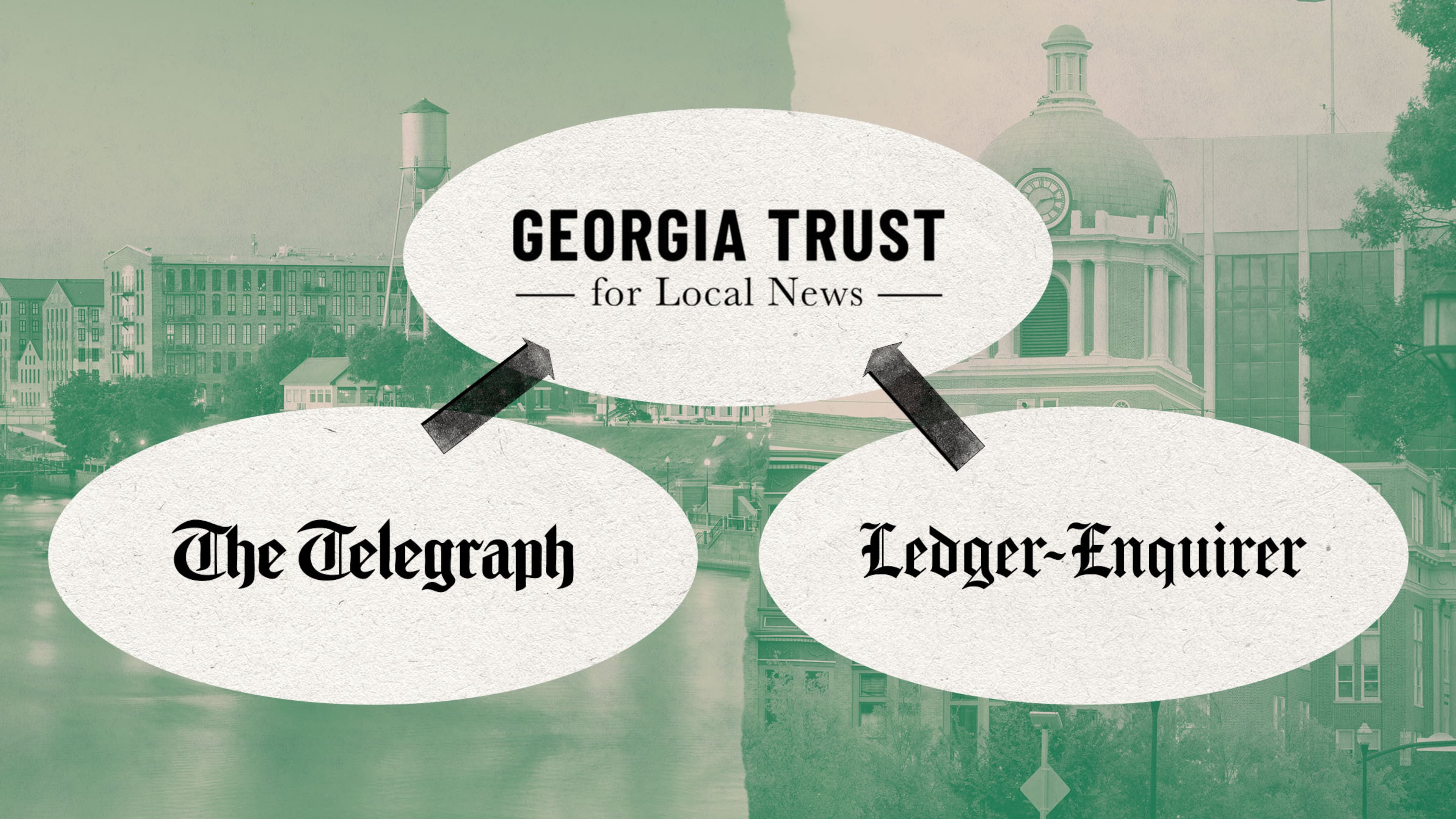

The Macon Telegraph and the Columbus Ledger-Enquirer have been acquired by a nonprofit devoted to revitalizing local news organizations, ending decades of corporate ownership for two of Georgia’s oldest newspapers.
California-based newspaper giant McClatchy sold the titles to the Georgia Trust for Local News, a subsidiary of the National Trust for Local News, according to a news release from the organization. Acquisition prices were not disclosed.
Cynthia DuBose, the executive director of the Georgia Trust, said the acquisition is a win for local journalism in both communities. The nonprofit will invest in expanding local coverage in both titles, both of which feature a large share of national and state coverage produced under McClatchy’s network.
“That is going to be an investment in how we cover the communities, but also I think there’s an investment on our part in becoming not just an information provider, but actually a part of the community,” DuBose said. “We are going to be visible to the community. That’s probably going to be a change for (readers) in ways that they might not have seen in the past.”
A grant from the Local News and Information Fund at the Community Foundation of the Chattahoochee Valley funded the acquisition of the Columbus paper. More than a dozen individuals and community stakeholders contributed to the fund, including Aflac.
The acquisition of the Macon paper was made possible by funding from the Peyton Anderson Foundation. Anderson is the former owner and publisher of The Macon Telegraph. He sold the paper to Knight Ridder, which was acquired by McClatchy in 2006.
The Georgia Trust now has 21 outlets under its portfolio, stretching across Albany, Dublin and other areas of Georgia. The National Trust also has subsidiaries in Maine and Colorado.
The Macon Telegraph will merge with the Macon Melody, a news startup founded in 2024 under the Georgia Trust’s network. The combined outlet will keep The Macon Telegraph name and operate out of Mercer University’s Reg Murphy Center for Collaborative Journalism. The Ledger-Enquirer, which currently operates out of a coworking space, will move into a new location in Columbus’ central business district at a later date.
The paywalls on both websites will lift for 30 days, giving past or future subscribers the chance to look at their coverage.
All but two of the newsrooms’ employees received offers under the new ownership, DuBose said. The ad and sales employees are part of McClatchy’s central office and were not part of the acquisition.
The Macon Telegraph was founded in 1826, and has undergone several name changes in its history. It continued to print through the Civil War, and won a Pulitzer Prize in 1985 for specialized reporting. The Ledger-Enquirer was founded in 1828 and won Pulitzer Prizes for public service in 1926 and 1955.
The deal comes at a challenging time for local newsrooms, with many facing significant financial pressures from declines in subscribers and advertising revenue, among other headwinds. In the first quarter of the 21st century, close to 3,500 newspapers ceased publication and have vanished, according to a 2025 report from Northwestern University’s Medill School of Journalism. Print newspaper circulation in the U.S. fell by about 80 million, down 70% from 2005 levels.
There is no one long-term solution to financially support newsrooms, especially those farther from major cities. But nonprofit journalism, which relies significantly on philanthropic funding rather than solely on subscriptions and ad sales, is a growing business model.
For-profit owners invest in their publications all the time and don’t just “take all the money and run away,” said Tom Wiley, the CEO of the National Trust. But nonprofit owners are investing in their organizations to improve the quality of life in their community, not to pay off their capital and see a financial return.
“Our model is to acquire these from for-profit owners, either independent or chains, and then try to centralize the services for efficiencies, and then invest that margin back into the newsrooms, the technology and the quality of coverage,” Wiley said.
Conversations around acquiring the two publications go back years, Wiley said. McClatchy made it clear to the organization that it needed to take both or neither. The National Trust viewed this as a plus.
The National Trust’s growth model uses philanthropic investments to accelerate local publishers’ ability to drive revenue, which can come from subscriptions, advertising, events and other sources.
“I think there’s a reengagement with the community and a reinvestment back into the potential of these organizations, which is why we did it,” Wiley said.