After East Palestine crash, a rail safety win but health questions remain

More than three years after a Norfolk Southern train derailed in East Palestine, Ohio in February 2023, the package of rail safety reforms it sparked has seen new life in Congress.
The Railway Safety Act, a bipartisan federal bill drafted in the wake of the disaster, stalled for years amid pushback from the railroad industry, including Atlanta-based Norfolk Southern.
But last month, with the urging of the White House and Vice President JD Vance, who cosponsored the act as an Ohio senator, the House Transportation and Infrastructure Committee added the bill into a major surface transportation package and passed it nearly unanimously.

It has a ways to go, requiring approval from another House committee and the full chamber as well as the Senate.
But for community members in East Palestine, the news was a milestone — albeit only one piece of the justice and compensation they’ve been seeking since the derailment thrust them into the news spotlight.
A $600 million class action settlement between residents and Norfolk Southern has been fraught with delays — and reports of lower-than-expected payouts. Other litigation against the railroad seeking further compensation, including a federal case by the Ohio attorney general, remain ongoing.
“The rail safety is great. The $10 million that (President) Trump gave (in February) for (East Palestine’s) economic recovery is great. But in order to ‘make this right,’ in the words of Norfolk Southern, it’s just not one thing or another,” said Jami Wallace, an East Palestine resident and community advocate.
“Yes, you need railroad safety to make sure this doesn’t happen again. But where they really failed us is the human health recovery of the residents. I just feel like the whole health aspect of it has been ignored,” she said.
Wallace, who has nearly 50 immediate family members within a mile of the derailment, said she thought her community would have a decade until the worst health effects started.
But, “We’re seeing not just cancer, but heart attacks. We’re seeing different thyroid diseases, respiratory issues.” She said she recently counted up more than 60 friends and locals with cancer diagnoses.
While causation between the derailment and these health issues hasn’t been proven, that doesn’t quell residents’ concerns.
Norfolk Southern made a “flawed” decision after the derailment, the National Transportation Safety Board said, to burn off the contents of tank cars carrying carcinogenic vinyl chloride to avoid an explosion. The burn sent a mushroom cloud over the town and surrounding area, which was temporarily evacuated.
One recently published pilot study showed a higher-than-average inflammatory response in the blood of locals five months after the derailment.
Norfolk Southern and Union Pacific — which plan to combine in a megamerger — each referred The Atlanta Journal-Constitution to their industry group, the Association of American Railroads, for comment on the rail safety legislation.
AAR CEO Ian Jefferies in a statement last month said the package “includes a wide range of extraneous mandates under the veil of safety that will only increase costs throughout the freight network and broader supply chain with no proven safety benefit.”
In a March interview, Norfolk Southern’s CEO Mark George told the AJC that the company has “fulfilled every single commitment that we’ve made” in its response to the derailment.
The company says it has spent more than $2 billion on compensation and litigation since the incident, including $5 million to overhaul the municipal drinking water system, and more than $4 million to establish a clinic in the community as well as support mental health care.
George and Union Pacific CEO Jim Vena told the AJC a merged company would continue to remain liable for any ongoing issues.
But George said Norfolk Southern has gone “above and beyond, cleaning things that were (in East Palestine) before the derailment.”
“We’ve given a lot of money. We’ve built community centers. We’ve done other things that we weren’t forced to do,” he said.
“Of course, you’re going to have people who might want to attribute unfortunate illnesses and other things to the derailment. I’m not going to speak about those things or litigation,” George said.
“All I know is, when we’ve been asked to do stuff, we’ve done it. We’ve fulfilled every obligation and did a lot on our own without even being asked to do so.”
‘A long time coming’
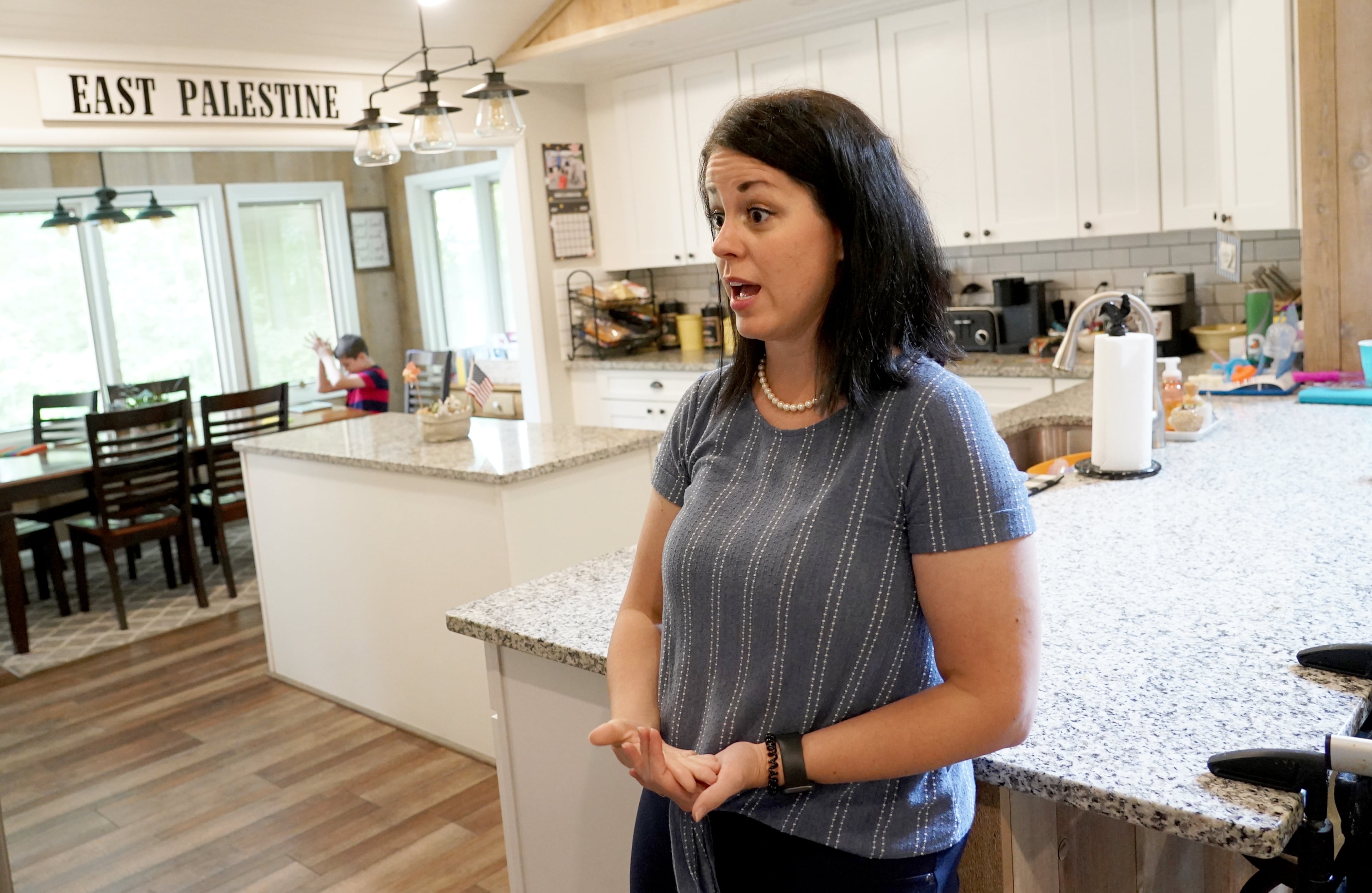
Misti Allison, an East Palestine community advocate with a public health background who lives a mile from the derailment site, applauded the rail safety legislation’s progress.
She testified before Congress about the derailment in 2023.
“It’s just been a long time coming,” she said. “Everything just takes so much longer to move forward than you think.”
The House committee attached the package to a five-year transportation bill that funds highways, bridges and transit. The current law expires Sept. 30, by which time either a full reauthorization or an extension is required, a committee spokesperson confirmed.
Allison is “cautiously optimistic” about its prospects given an overwhelming bipartisan 62-2 committee vote. “It wasn’t a close call. That was really Congress telling the railroad industry that the status quo is over, hopefully.”
Still, she noted, “That same industry pressure that blocked this for three years doesn’t disappear overnight.”
And the industry has continued to argue the legislation reaches needlessly beyond the actual causes of the derailment and hamstrings its ability to progress.
Among its many provisions are some specific NTSB recommendations made after the derailment, including mandated wayside defect detection technology for train inspections, an expanded definition of hazardous materials to include materials like vinyl chloride and increased rail safety violation penalties for companies.
But the bill also includes a two-person crew minimum mandate, and rules about railcar inspections, which the industry argues will increase costs and decrease efficiency.
“At a time when Congress is simultaneously greenlighting autonomous transportation technologies in other sectors, efforts to include rail policies that lock yesterday’s operating models into federal law are nothing more than hypocrisy,” AAR’s Jeffries said in May.
“This approach is particularly misguided given that 2025 marked the safest year in freight rail industry history across several key safety measures, including historic lows in derailments, equipment-caused accidents, track-caused accidents, and employee injury rates,” he added.
But in a letter to Congress last month, NTSB Chair Jennifer Homendy pushed back.
“Despite assertions that 2025 is the safest year yet,” Homendy wrote, “according to the Federal Railroad Administration, the number of employee fatalities and the derailment rate per million train miles have remained flat.”
“The safety of rail operations in the United States remains an open challenge,” she said.
The board has increased its number of rail investigations each year, including by 33% in 2025 over 2024, she said.
Earlier this year, the NTSB confirmed to Norfolk Southern the railroad had completed four of the five safety recommendations the board gave it following its derailment investigation in 2024.

‘There’s power in numbers’
For all the focus on rail safety, Allison and Wallace say many in East Palestine are more focused on their health.
“A lot of people that I talk to that have been pretty sick,” Allison said.
As community liaison for the East Palestine Train Derailment Health Research Program tracking long-term health effects, she frequently hears their stories.
There are a lot of reports of thyroid conditions, she said.
“Things like asthma. People are still having lots of bad headaches. You have some people that are having cancer,” Allison said.
“But is it correlation or is it causation? We’re not able to directly discern that yet.”
“However when something like this comes up, and you see about somebody in the community that’s having a really rare neurological condition for instance, you wonder, ‘Is it because of February 2023?’ And only time will tell. But it definitely weighs very heavy on the community,” Allison said.
The recent study showing an increased inflammatory response in East Palestine residents has been shared widely, she said.
Prior pilot studies had found normal indoor air quality in East Palestine in September 2023 and April 2024, as well as an absence of toxic dioxins in wristbands worn by locals to test air quality months after the derailment in 2023.
“I think so many people felt gaslighted. Like what people were feeling, or symptoms that people were experiencing was just in their heads, or it was just nerves or stress,” she said.
It’s why she is advocating for participation in the ongoing and expanded studies, which the federal government dedicated another $10 million toward last year.
“If we don’t get people collectively signing up we won’t be able to tell for sure what’s going on,” she said.
The railroad previously agreed to commit $25 million to a 20-year community health monitoring program through a 2024 federal consent decree, but it remains pending in federal court.

But Mindy Bish says she doesn’t need to wait for studies to prove that residents have suffered health impacts from the derailment.
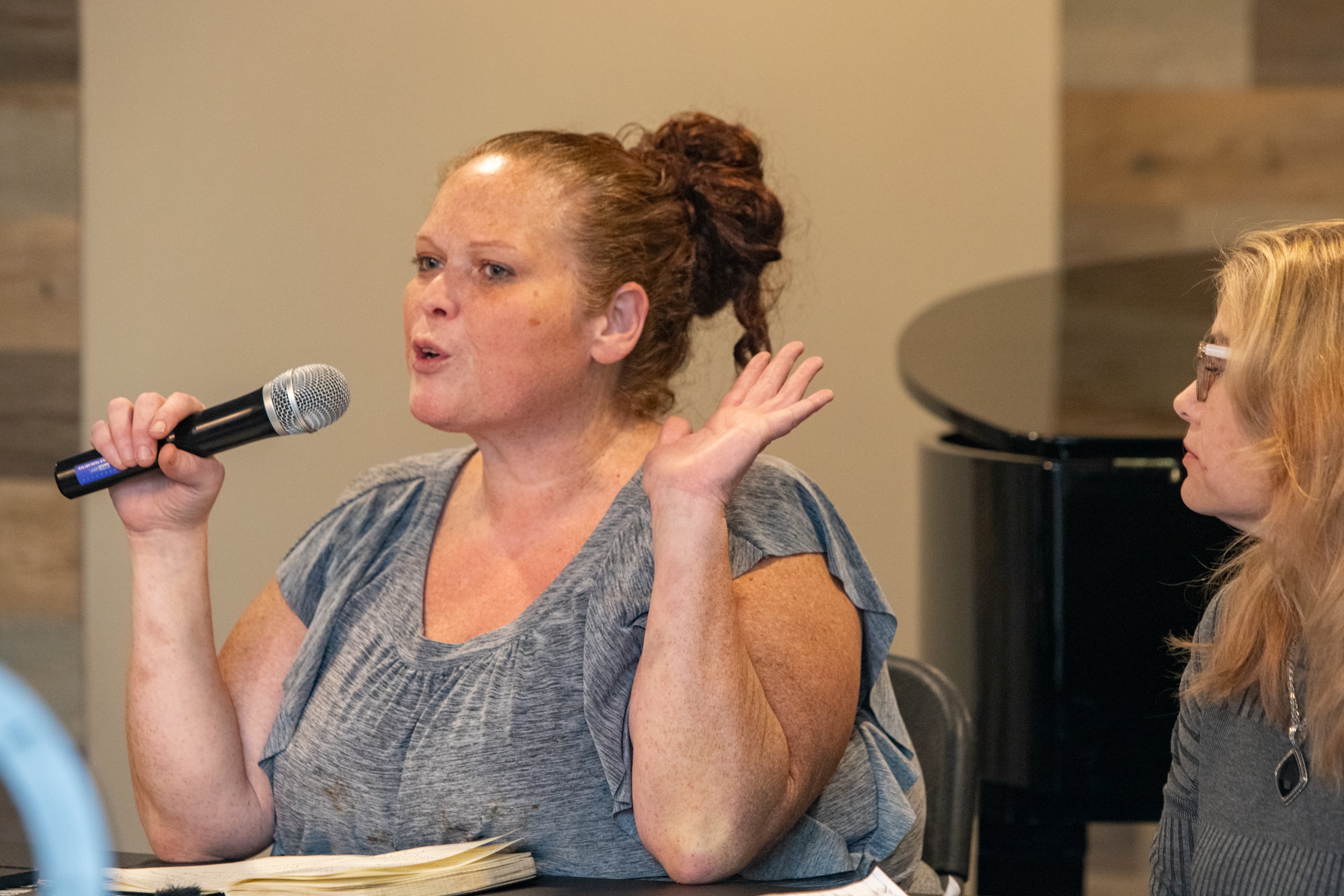
The attorney with Keenan Law and Bish Law is lead counsel for more than 1,000 East Palestine residents suing Norfolk Southern in state court, alleging that their responses to the cleanup failed to protect the community — and that the class action settlement failed to compensate them fairly.
She has also intervened in the ongoing federal case by the Ohio Attorney General.
“It is not hard at all to prove,” Bish said.
“These are otherwise healthy human beings who end up with a tumor in their lungs that suffocate them to death. Lymphoma. Rare cancers that no one can figure out.”
Bish is representing families seeking compensation outside of the class action settlement — as well as those who opted in but aren’t satisfied with their payouts.
One of her clients, she said, opted into the class action. Despite having had two forms of cancer since the derailment, Bish said, this client only received $2,400.
In a prior interview, Norfolk Southern CEO George told the AJC they realize people have been frustrated by the class action payout delays.
“But that’s not Norfolk Southern’s fault. That was the fault of some lawyers who wanted it hung up as they tried to extract more,” he said.
The class action settlement’s administrator, Kroll Settlement Administration, was removed from the case and ordered to pay more than $17 million for mishandling personal injury payments from the case last year.
“In my opinion, the attorneys screwed us. They lied to us. They failed the people,” Wallace said.
She said she tried to warn people not to join, as doing so also waived future liability claims.
Wallace, who founded the Chemically Impacted Communities Coalition, said she had a meeting at the White House this spring about what her community still needs.
Among the many solutions she’s proposing are a major emergency disaster declaration and a federal medical fund to cover residents’ treatment.
She’s also pushing for a congressional field hearing in East Palestine to publicly assess the federal response.
But she said she still hasn’t heard any promised follow-up from that White House meeting.