
There were whorls of bright red. Modernist swaths of green and black. A man with a piercing gaze. A young woman with an innocent smile.
These visuals are what greeted visitors from across the globe who in 1900 stopped by an exhibit in the corner of a large, nondescript white building on the banks of the Seine.
There they perused hundreds of photographs, more than 60 charts and maps, and hundreds of books and periodicals all focused on one thing: presenting on the world stage a thorough and accurate accounting of the achievements of one group of human beings.
This was the “Exhibit of American Negroes.”
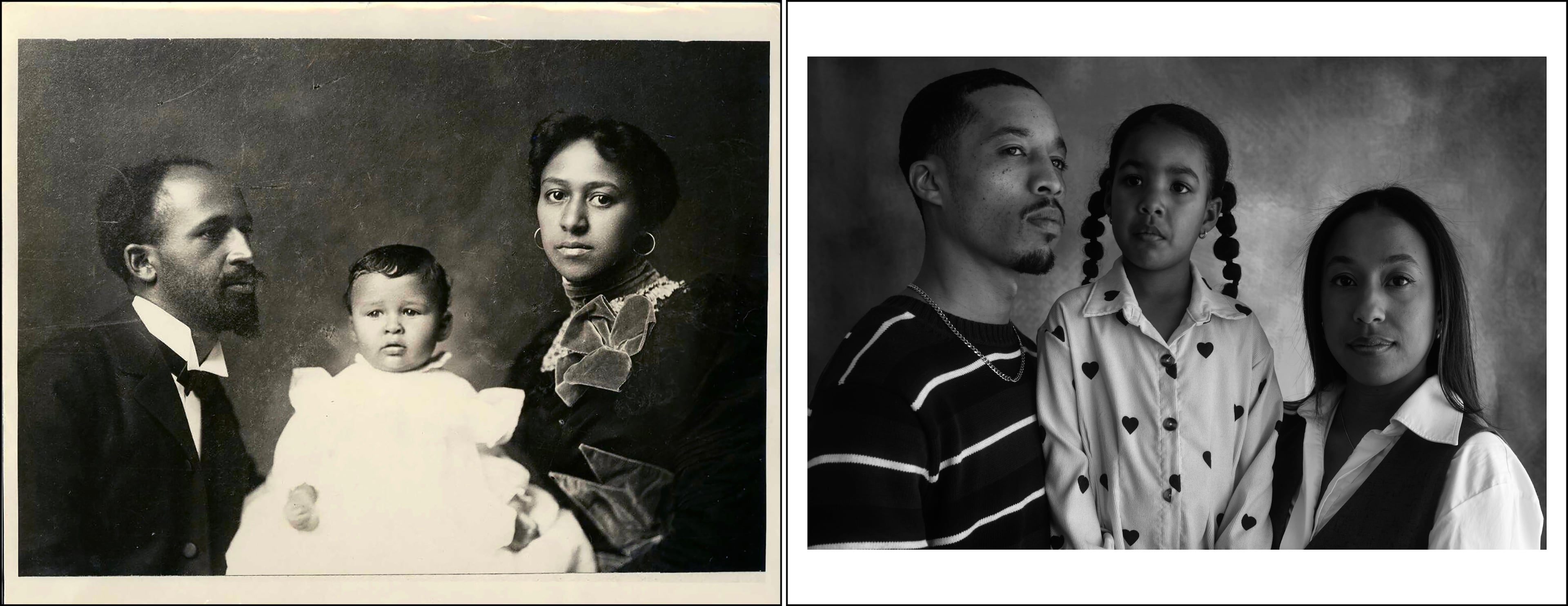
At left, a portrait of W. E. B. Du Bois, his son Burghardt and wife Nina taken in 1898. In 1900, Du Bois presented hundreds of portraits and scenes of Black American life for his “Exhibit of American Negroes” at the World’s Fair in Paris in 1900. (Special Collections and University Archives, University Libraries, University of Massachusetts Amherst) At right, Julien Virgin, a multimedia journalist at WABE, along with his 5-year-old daughter Sorai and his wife, Geneley Virgin, pose for a portrait in Atlanta on Thursday, Jan. 15, 2026.

Original: Value of furniture between 1875 and 1899; Updated: Georgia median household income for Black, white and all households in 2024
Updated Illustration: Marcie LaCerte for the AJC | Source: Courtesy of the Library of Congress; Data Analysis by Stephanie Lamm/AJC
Much of the work of the exhibit was spearheaded by renowned scholar, journalist, sociologist and activist W.E.B. Du Bois. He presented it at the 1900 Exposition Universelle, a world’s fair held in Paris. Du Bois’ goal was to push back on the dominant racist narratives of the time by showing what Black Americans had been able to achieve in less than 40 years after the end of slavery.
“We have thus, it may be seen, an honest, straightforward exhibit of a small nation of people, picturing their life and development without apology or gloss, and above all made by themselves. In a way this marks an era in the history of the Negroes of America,” Du Bois wrote at the time.
At the turn of the 20th century, Black people were still considered innately inferior to other races and “had been projected across the world as deserving slavery and deserving Jim Crow,” said Aldon Morris, emeritus professor of sociology and Black studies at Northwestern University and author of “The Scholar Denied: W. E. B. Du Bois and the Birth of Modern Sociology.”
“Du Bois’ motivation was Black liberation at the time, and he used the exhibit as a weapon to try to attain that liberation,” Morris said.

At left, a portrait of four students sitting on the steps at Atlanta University taken by Thomas Askew. At right, Spelman College students (from left) Grace Lisbon, Max Brown, Sanaa Stokes, Nia Simone Wharton and Delaney DeShields sit on the steps of Howard-Harreld Hall on Wednesday, Jan. 14, 2026.

Original: Professions of Atlanta University graduates; Updated: Degrees awarded to Black students by AUC institutions since 1988 (when Clark College and Atlanta University merged)
Updated Illustration: Marcie LaCerte for the AJC | Source: Courtesy of the Library of Congress; Data Analysis by Stephanie Lamm/AJC
Du Bois, then a professor at Atlanta University, had been pioneering sociological studies of Black Americans. He believed he could use science and statistics to determine the causes of racial inequality and thus show social conditions were responsible for Black people being at the bottom of the social order, not an innate superiority of another race.
For the exhibit, along with his Atlanta students and a network of alumni, he created the data visualizations to present his scientific findings in a clear, digestible format, a groundbreaking use of infographics at the time. About half the charts were focused on the conditions of Black Americans in Georgia and Atlanta. They also displayed three large volumes compiling the racially discriminatory laws of Georgia from colonial times to the end of the 19th century.

LEFT | Original: Where African Americans living in Georgia in 1890 were born; Updated: Migration of Black people into Georgia in 2023
Updated Illustration: Marcie LaCerte for the AJC | Source: Courtesy of the Library of Congress; Data Analysis by Stephanie Lamm/AJC
RIGHT | Original: Black population of each county of Georgia, 1890; Updated: Black population of each county of Georgia, 2024
Updated Illustration: Marcie LaCerte for the AJC | Source: Courtesy of the Library of Congress; Data Analysis by Stephanie Lamm/AJC

Original: Black population in small and large cities compared with rural environments, 1890; Updated: Black population in small and large cities compared with rural environments of Georgia, 2024
Updated Illustration: Marcie LaCerte for the AJC | Source: Courtesy of the Library of Congress; Data Analysis by Stephanie Lamm/AJC
But the exhibit was not just science. It was art.
Alongside the striking charts and maps, Du Bois displayed 500 photographs of Black Americans. A good portion of those photographs were taken in Georgia, and Atlanta photographer Thomas Askew shot many of the images.
“Those photographs were very, very important to document the progress that Black people had made,” Morris said.
Du Bois wanted people who believed Black people were subhuman and inferior to see for themselves proof to the contrary.

At left, African American man, half-length portrait. At right, Mohamed Dolly, a sophomore biology student at Clark Atlanta University, poses for a photo in Atlanta on Thursday, Jan. 22, 2026.
“You have all these photographs of doctors and lawyers and entrepreneurs and homeowners and students studying to be lawyers and doctors and so forth,” Morris explained. “He’s trying to use every product he can get his hands on ... to show the world who Black people really are and that, if given the opportunity, they can progress like any other people in the world.”
Du Bois and his collaborators also wanted to show the world the educational attainment of Black Americans and the breadth of their literature. As part of the exhibit they displayed records of hundreds of patents granted to Black men and a bibliography from the Library of Congress of 1,400 titles written by Black Americans. They showed 200 of those works in the exhibit along with many of the Black periodicals of the time.
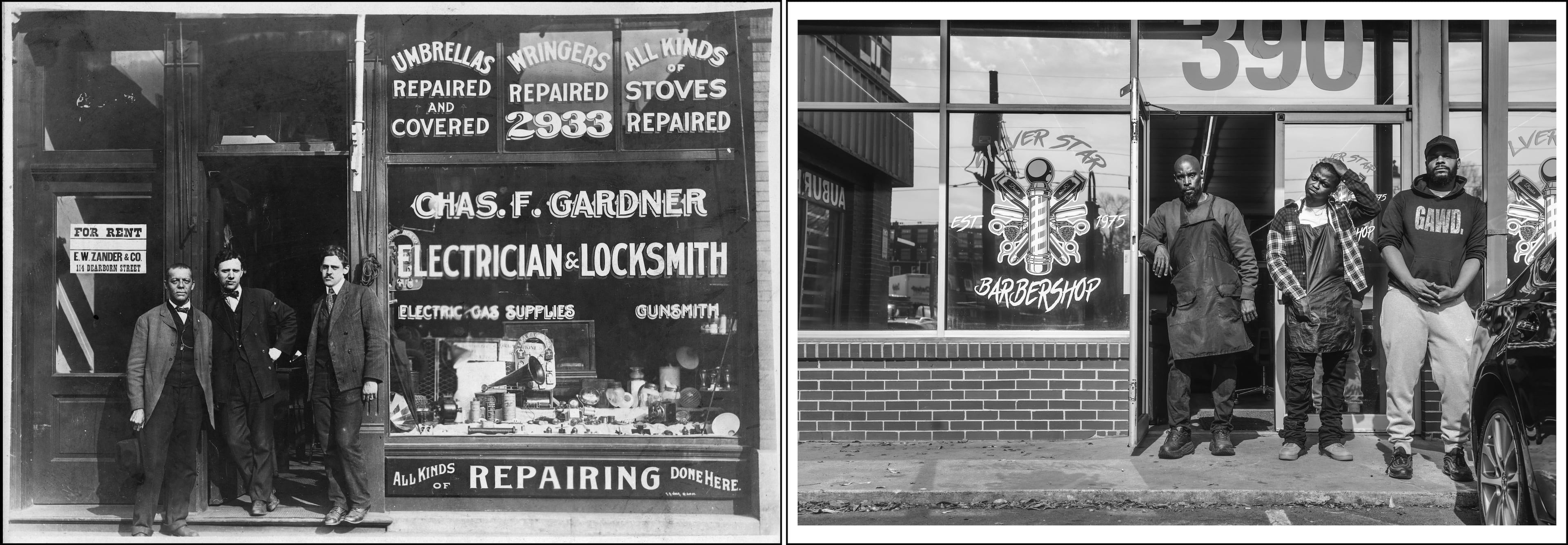
At left, three men stand at the entrance to the business establishment of “Chas. F. Gardner Electrician and Locksmith” at 2933 State St. in Chicago. At right, Horace Robinson (left), owner of Silver Star Barbershop on Auburn Avenue in Atlanta, poses for a portrait in front of the building with barbers Devin Pittman and Brandon “Duke” Graham on Tuesday, Feb. 3, 2026.

Original: Relative number of African Americans in various businesses; Updated: Industries with the greatest share of Black workers in Georgia
Updated Illustration: Marcie LaCerte for the AJC | Source: Courtesy of the Library of Congress; Data Analysis by Stephanie Lamm/AJC

Original: Percentage of African Americans in various occupations by sex; Updated: Share of Black men and women in Georgia occupations
Updated Illustration: Marcie LaCerte for the AJC | Source: Courtesy of the Library of Congress; Data Analysis by Stephanie Lamm/AJC
Morris said the exhibit and Du Bois’ earlier sociological studies helped inform one of his seminal works, “The Souls of Black Folk,” a book of essays published in 1903.
But despite the exhibit winning multiple medals at the Paris Exposition and subsequently touring in a few cities in the U.S., for most of the 20th and early 21st centuries, Du Bois’ contributions to data visualizations and sociology were ignored.
“Du Bois was way ahead of his time,” Morris said. “He was producing what we call visualizations in social science and in the humanities. And so now the academy and scholars, a century later, are profoundly catching up to what Du Bois was doing in those exhibits.”
Now, more than 125 years after Du Bois presented his works in Paris, The Atlanta Journal-Constitution has re-created a handful of the visualizations with contemporary data and the photographs with modern looks at the lives of Black Georgians.
New Photos by Natrice Miller
Historic photos courtesy of the Library of Congress except where otherwise noted.

At left, a portrait of Summit Avenue Ensemble taken by Thomas Askew in 1899 or 1900. At right, Rhapsody in Ebony ensemble poses for a portrait in Atlanta on Thursday, Jan. 15, 2026.

At left, African American woman, head-and-shoulders portrait, facing right. At right, Chloe Walker, a senior elementary education student at Clark Atlanta University, poses for a photo in Atlanta on Thursday, Jan. 22, 2026.

At left, African American man, half-length portrait. At right, Fahamu Pecou, visual artist and founder of African Diaspora Art Museum of Atlanta (ADAMA) poses for a photo in Atlanta on Thursday, Jan. 15, 2026.

At left, African American man, half-length portrait. At right, Ian Moore, founder of Glaciers Italian Ice, poses for a photo in Atlanta on Saturday, Jan. 17, 2026.

At left, Young African American man, half-length portrait. At right, Caleb Murray, 17, poses for a photo in Atlanta on Saturday, Jan. 17, 2026.

The three portraits that span the top row are all labeled as “African American man, half-length portrait” at the Library of Congress. Across the bottom row (from left), Antonio Mayo, 14, Trae’mone Ellison, 15, and Djxani Washington, 14, pose for photos in Atlanta on Saturday, Jan. 17, 2026.

At left, African American woman, half-length portrait. At right, Rosalynne Duff poses for a portrait in Atlanta on Thursday, Jan. 22, 2026.

At left, a portrait of the Rev. Henry Hugh Proctor, pastor of First Congregational Church in Atlanta, taken in 1899 or 1900. At right, the Rev. Dwight Andrews, the current pastor of First Congregational Church in Atlanta, poses for a photo on Friday, Jan. 16, 2026.

At left, a photo of The Morris Brown College Ball Club taken in 1899 or 1900. At right, the Morris Brown College Fighting Wolverines eSports team poses for a photo inside the eSports lab on Tuesday, Feb. 3, 2026.

At left, portrait of an African American woman. At right, Kelly Cadet-Lyons, owner and founder of R-KI-TEKT, an online retailer of modern and artful accessories, poses for a photo in Atlanta on Thursday, Jan. 15, 2026.

At left, African American man, half-length portrait. At right, physician Robert Rusher poses for a photo in Atlanta on Saturday, Feb. 7, 2026.

At left, a sewing class at Haines Normal and Industrial Institute in Augusta taken in 1900. At right (from left), Lillian Richards, a second-year computer science student, and Delee Faison, a senior psychology student, sew at the Mary Schmidt Campbell Center for Innovation & the Arts at Spelman College on Tuesday, Feb. 3, 2026.

At left, A portrait of W.E.B. Du Bois, taken by Cornelius M. Battey in 1918. At right, Clark Atlanta University President George T. French poses for a photo in Atlanta on Thursday, Jan. 22, 2026.
How we got the story
This was the perfect storm. In December, a call went out to the full Atlanta Journal-Constitution staff asking for ideas for the 2026 Black History Month Series. The first to respond was Mirtha Donastorg.
She marched over to Black culture reporter Ernie Suggs, who has coordinated Black History Month coverage for 11 years, and said she wanted to recreate the spirit and research of what Du Bois wanted to do in 1900 at the Paris Exposition, particularly the data visualizations.
But what about the photographs that accompanied the work? Suggs reached out to Natrice Miller, who along with being a photographer at the AJC, is a photo-based artist and filmmaker, who has had her work exhibited all over the country. She knew all about the photos and the primary photographer, Thomas Askew. She was in. Throughout January and February, Mirtha and Natrice got to work.

From left, AJC journalists Natrice Miller, Mirtha Donastorg and Ernie Suggs.
Mirtha worked with data reporter Stephanie Lamm on the research and finding contemporary data to match what Du Bois had discovered, before turning it over to our graphics team, who painstakingly re-created the colorful graphs.
Meanwhile, Natrice combed through hundreds of Askew photos — many of which were shot in Atlanta — to find the perfect fit.
Photo editor Bita Honarvar worked on photo selection and stitched together the original and new images for side-by-side comparison.
To recreate the “Exhibit of American Negroes,” which Du Bois called, “an honest, straightforward exhibit of a small nation of people, picturing their life and development without apology or gloss,” Natrice found her subjects in doctors and preachers and creators. A student she bumped into on the campus of Clark Atlanta University while she was on her way to shoot the school’s president became another subject. We even found a distant niece of one of the young students photographed in 1900. The resemblance was stunning. And so is this piece.