Atlanta neighborhoods are healthier, safer and more stable than a decade ago

Every so often a city produces a piece of data so good that it deserves to be read twice.
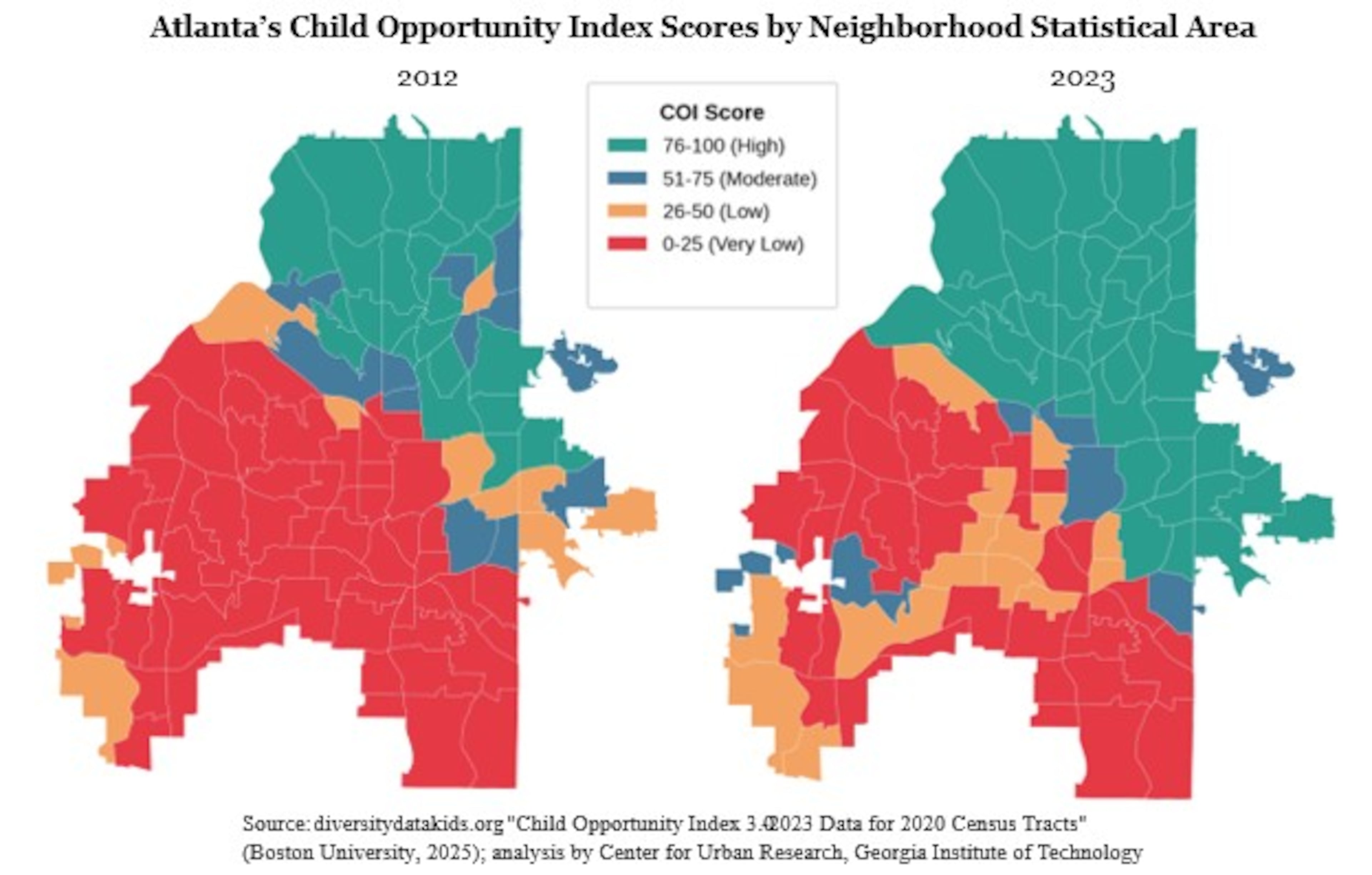
The city’s new State of Atlanta’s Neighborhoods report contains one: between 2012 and 2023, Atlanta’s Child Opportunity Index score — a nationally-normed composite measure of the social, economic, environmental and educational conditions that shape whether a child gets a fair shot in life — rose from 39 to 60 on a 100-point scale.
That is not modest improvement. That is a city moving, in little more than a decade, from the bottom third of American cities into the middle of the pack.
The gains in the quality of life in our city are not confined to neighborhoods that were already thriving, which is often how these things go — the rich get richer and the map calcifies.
They occurred most dramatically in places that had the furthest to climb. Neighborhoods that ranked among the lowest-opportunity communities in the nation a decade ago experienced some of Atlanta’s largest improvements.
That is critical, because it means opportunity has become more evenly distributed across the city. Atlanta’s neighborhood Gini coefficient — a measure of how unevenly opportunity is spread across the city — fell from 0.55 to 0.38, representing a substantial reduction in geographic inequality.
In a country where discussions of urban inequities often begin with the assumption that disparities only widen over time, Atlanta offers evidence that the opposite can happen.
Challenge of housing affordability persists

How did this progress occur?
Mostly due to years of deliberate public and private investment: new parks and trails, complete streets, expanded access to healthy food, mixed-income housing, neighborhood revitalization initiatives, and sustained private investment along corridors such as the Beltline, Memorial Drive, and Hollowell Parkway.
These gains are the result of choices made by civic leaders, nonprofit organizations, businesses, and residents over many years.
The lesson is that neighborhood conditions are not fixed. Public policy matters.
Cities possess far more capacity to shape opportunity than contemporary political debate often acknowledges.
The evidence reaches well beyond a single index. Major crime in Atlanta has fallen by 47% since 2010. Residential vacancy — a reliable indicator of neighborhood distress—has been cut nearly in half.
More people are choosing to live in the city, and more families are investing in its future. However one measures it, the typical Atlanta neighborhood today is healthier, safer and more stable than it was a decade ago.
Opportunity did not simply expand where it already existed. It spread. But it didn’t spread evenly or fairly.
Despite this progress, the same report makes clear that 37 neighborhoods, concentrated primarily on the west, southwest and south sides of the city, continue to experience deeply entrenched disadvantages.
Fourteen remain among the nation’s lowest-opportunity communities. Atlanta’s progress has been broad, but it is by no means complete.
The report also identifies the city’s next great challenge – balanced and inclusive growth. Some of the neighborhoods that improved the most have become increasingly difficult for low- and even middle-income residents to afford
In communities such as Edgewood, Kirkwood, East Atlanta and Cabbagetown, rising homeownership and declining poverty have coincided with substantial demographic change. These neighborhoods succeeded in becoming healthier, safer and more desirable — but, in doing so, became less accessible to many of the families who weathered the difficult years before reinvestment arrived.
This is not evidence that neighborhood revitalization has failed. It is evidence that success creates new responsibilities.
That tension — between a neighborhood getting better and a neighborhood remaining accessible to families across the income spectrum — is the unfinished chapter of an otherwise remarkable stretch.
Nearly half the city’s housing stock is now unaffordable to a family earning the region’s median income, and the neighborhoods with the deepest, most durable opportunity are disproportionately the ones where working families have the fewest options.
Cities are still primed to solve problems

The next phase of Atlanta’s neighborhood strategy must therefore focus not only on expanding opportunity, but on preserving access to it.
Mayor Andre Dickens’ commitment to build or preserve 20,000 affordable housing units is critical, as is his dedication to institute an expansive anti-displacement playbook, and to ensure that every Atlanta neighborhood can thrive are keys to ensuring Atlanta can stay Atlanta. And this commitment to protect accessibility must be institutionalized — part of the DNA our public, private, and philanthropic civic realm — to ensure that Atlanta remains Atlanta, and not another Seattle, San Francisco or Austin-flavored cautionary tale.
Too often, public debate forces cities into false choices. Either neighborhoods are improving or they are gentrifying. Either public investment works or it doesn’t. The reality is more complicated — and far more encouraging. Atlanta demonstrates that neighborhoods can become dramatically healthier while simultaneously revealing the importance of protecting affordability as those improvements occur. Those are not contradictory lessons; they are sequential ones.
Cities are frequently judged by the problems they have not yet solved. They should also be judged by whether they are learning how to solve them. Atlanta has not eliminated neighborhood inequality, but it has shown that neighborhood inequality can be reduced. And in doing so, it has revealed what the next chapter of successful urban policy must address.
Americans have argued for decades about whether cities still possess the ability to shape opportunity. Atlanta’s experience suggests the better question is whether they choose to. Neighborhoods do not improve by accident. They improve because people make sustained commitments to improve them. The lesson of the past decade is not that Atlanta has arrived. It is that deliberate, place-based investment works.
That is a reason not for complacency, but for confidence. Atlanta’s success will ultimately be measured not by how prosperous its strongest neighborhoods become, but by whether every neighborhood becomes a place where every child has a genuine opportunity to thrive.
David Edwards, senior policy adviser for neighborhoods, City of Atlanta and founder and co-director for the Center for Urban Research at the Jimmy and Rosalynn Carter School of Public Policy at the Georgia Institute of Technology.
Send letters to the editor of 250 words or fewer with your name, city or town and contact information to letters@ajc.com.