Georgia Republicans reined in the gerrymandering war. Now change the system.

Like others concerned about the health of American democracy, we were glad to see the Georgia General Assembly turn down an opportunity to further gerrymander its U.S. House of Representatives districts during a special legislation session in June.
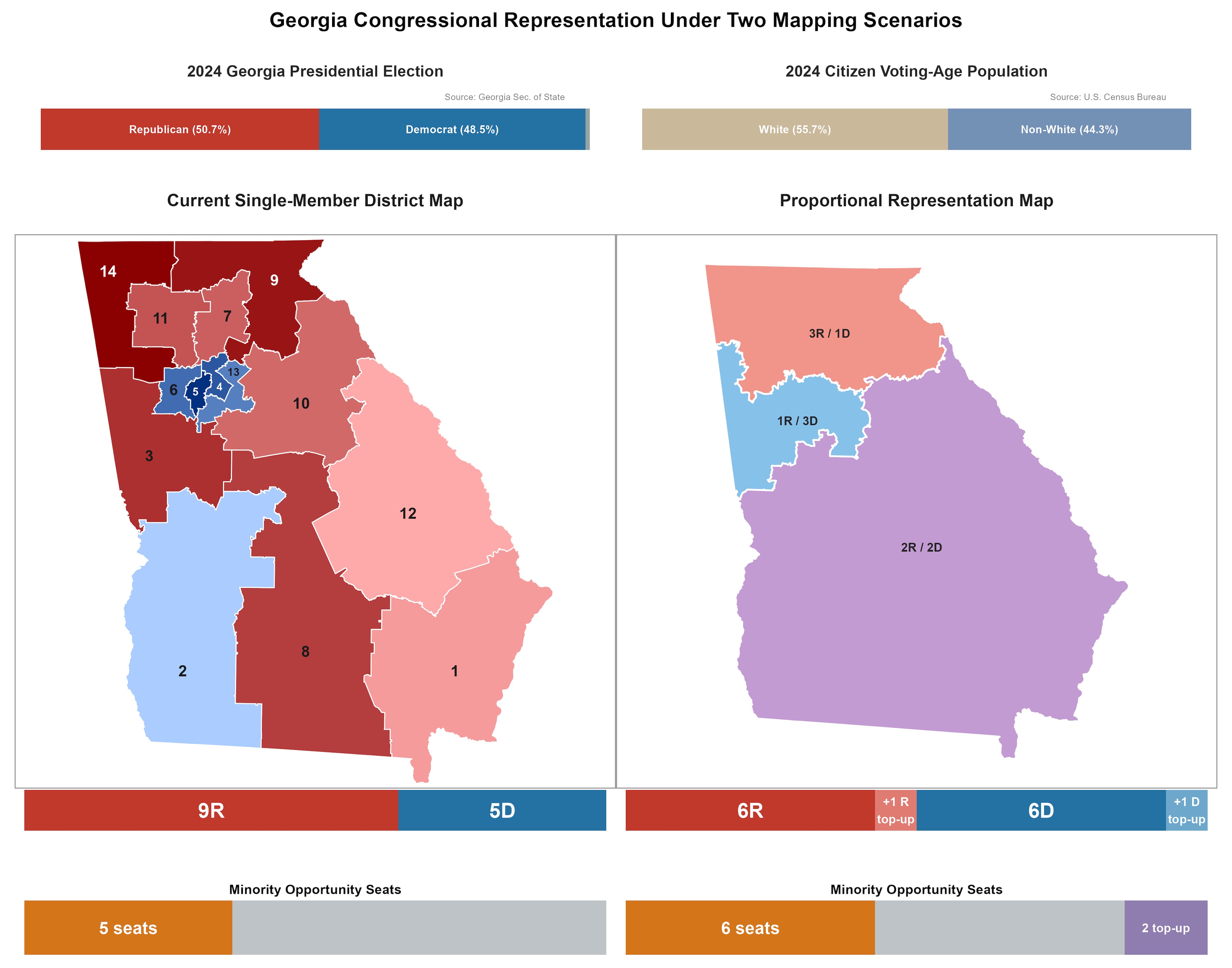
Georgia is already a 50-50 red vs. blue state with a nine-to-five Republican versus Democratic House delegation and zero competitive seats. Fortunately, Republican legislative leaders have (for now) declined to join 10 other states that have redrawn their lines for partisan advantage since last August.
These gerrymanders have created a real possibility that the House will soon be controlled by the party that received fewer total popular votes, an outcome not seen since 2012.
As Georgia residents and voters, we celebrate any effort to de-escalate the gerrymandering “war” that threatens American democracy, especially since the Supreme Court now allows states to break up majority Black seats for partisan advantage.
But as political scientists who study electoral systems, we know the problem goes deeper than the recent gerrymandering and cannot be solved without reforming our electoral system.
Here’s how the proportional representation system works
The fundamental problem is that House members are elected in single-winner districts, a system that forces mapmakers to choose between values like minority representation and partisan fairness, leaves a substantial share of voters without representation from candidates they voted for, and is very easy to gerrymander.
Reforms like independent redistricting commissions and bans on partisan gerrymandering can make things better, but they still leave in place a deeply flawed system that distorts electoral outcomes no matter what.
We need a complete overhaul, not tweaks around the edges. The United States should join most other advanced democracies and use proportional representation to elect legislators.
In proportional systems, representatives are elected from multi-member districts with the seats divided up based on the vote share each party received. For example, House seats could be elected from districts with four members each. If the district has a 50% partisan split, two seats would go to Republicans and two would go to Democrats. And if racial minorities made up at least 20% of the district and voted together, they would have the opportunity to elect a candidate of their choice.
Using computer simulations, we examined what Georgia would look like if the 14 House seats were allocated to three districts that elect 4 members proportionally and two “top-up” seats that correct for deviations from the statewide vote (i.e., if Democrats won 50% of the statewide vote but only five of 12 seats, they would receive both top-up seats to ensure a seven-seven delegation).


Our results showed that proportional maps do a much better job of representing Georgia’s 50-50 partisan divide and racial demographics than the single-winner maps.
All simulated maps reflect Georgia’s even partisan split with a seven-Democrat, seven-Republican delegation and most provide at least six opportunities for minority voters to elect their preferred candidates. Moreover, each of the three multimember districts always elected at least one Democrat and one Republican, meaning every Georgian would be represented by a member from their party regardless of where they live.
Idea is gaining momentum, but the law must be changed

Gerrymandering was basically nonexistent in our maps. Proportional districts cannot be manipulated like single-winner districts, where parties can win more seats simply by shifting voters between districts. When voters are shifted in proportional systems, the gains in one district are almost always offset by losses in the other district because the share of the vote in the district is what is important, not just who gets the most votes.
The benefits of proportional representation go beyond fair representation. Proportional systems usually have more than two major political parties (something that more than 60% of Americans would welcome) because third party candidates do not need to capture a majority of the vote in a district to be elected. We believe additional parties would likely arise if the United States used proportional representation and that voters would be happier with their choices.
Proportional representation is gaining momentum due to the efforts of scholars, activists, citizens, and even some politicians. To implement it, we would need to repeal, or amend, a federal law that requires states to use single-winner districts in House elections. We also need to increase awareness. Most Americans have never heard of proportional representation, but they tend to like it once it’s explained. New Zealanders made the switch in 1996 after a well-informed public debate and the transition went smoothly.
American politicians, including Georgia’s leaders, need to call a permanent truce in the gerrymandering wars and start seriously discussing a system that can provide fair representation for more Americans. Other countries use proportional representation because it makes democracy stronger. We should join them.
Will Horne is an assistant professor of political science at Clemson University, where he studies electoral politics and political representation. Rob Oldham is an assistant professor of political science at Agnes Scott College in Decatur, Georgia. His research focuses on politics and lawmaking in Congress and state legislatures.
Send letters to the editor of 250 words or fewer with your name, city or town and contact information to letters@ajc.com.