Business

Looking back: How the 1996 torch relay launched Atlanta’s Olympics
Los Angeles kicked off the torch relay for Atlanta’s Games in 1996. For 2028’s L.A. Games, Atlanta will return the favor.
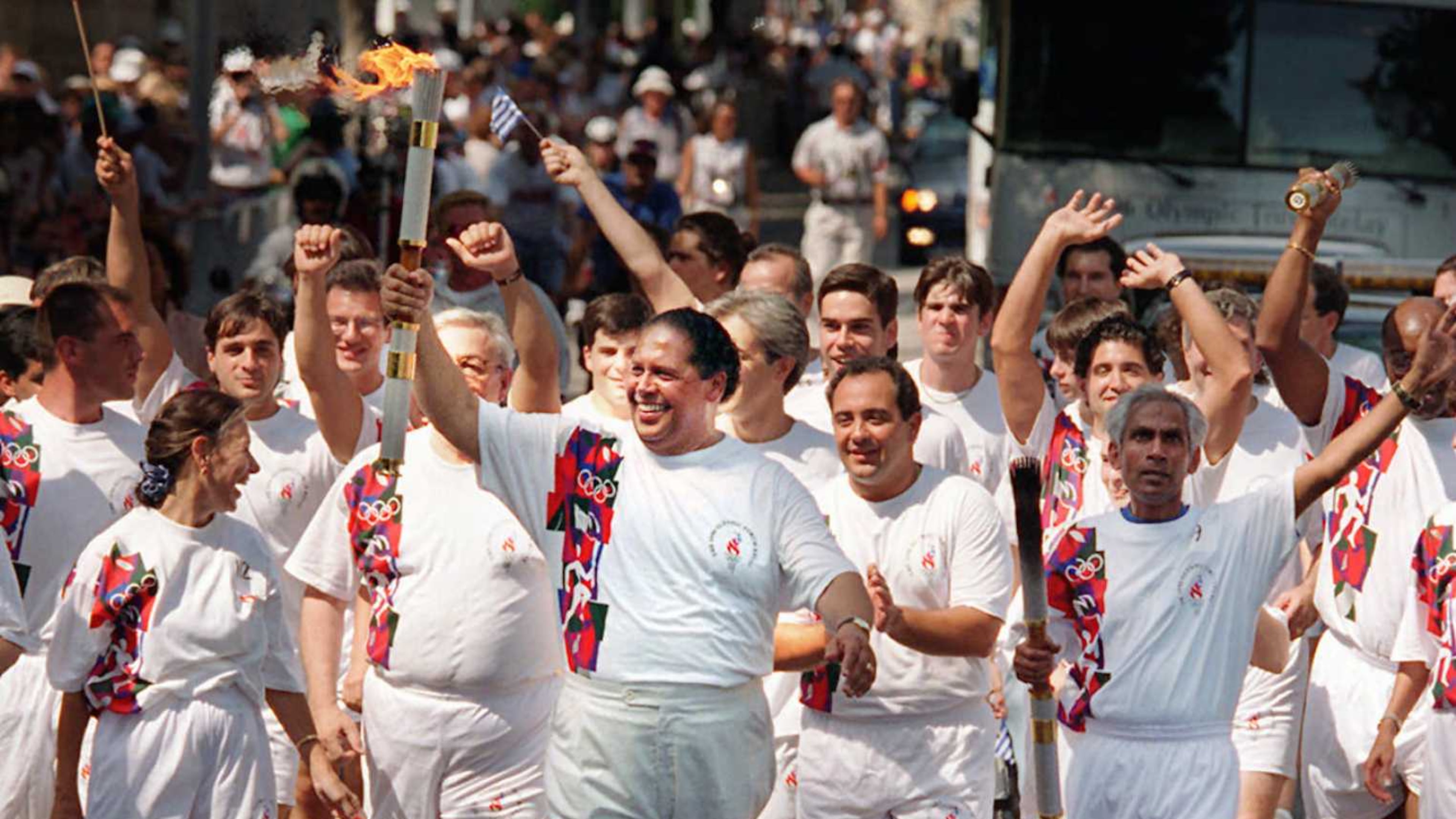
Former Atlanta Mayor Maynard Jackson (center) carries the torch up Washington Street on its way to City Hall on Friday, July 19, 1996, for a final ceremony before heading to the Olympic Stadium for the Opening Ceremonies of the 1996 Summer Olympic Games. (Greg Lovett/Palm Beach Post/Cox Newspapers)
45 minutes ago

In 1996, as Atlanta readied to host the Centennial Olympic Games, a torch relay kicked off in Greece that would ultimately traverse more than 16,000 miles in the U.S.

At the time, it was the longest Olympic torch relay in the U.S., an epic buildup for Atlanta, the first American city in the South to play host to the Games, an event that would catapult the budding metropolis onto an international stage.

“The world knew nothing about the American South,” Billy Payne, president and CEO of the 1996 Atlanta Committee for the Olympic Games, said Tuesday following the announcement that Atlanta will be the first U.S. stop for the torch relay ahead of the 2028 Olympic Games in Los Angeles.

“We were so proud of our ability to show the world that … we are the greatest example of a Black and white city working together, loving each other,” he said.

President and CEO of the 1996 Atlanta Committee for the Olympic Games Billy Payne (right) smiles during the LA28 Olympic Torch Relay announcement at City Hall in Atlanta on Tuesday, Sept. 29, 2026. (Abbey Cutrer for the AJC)
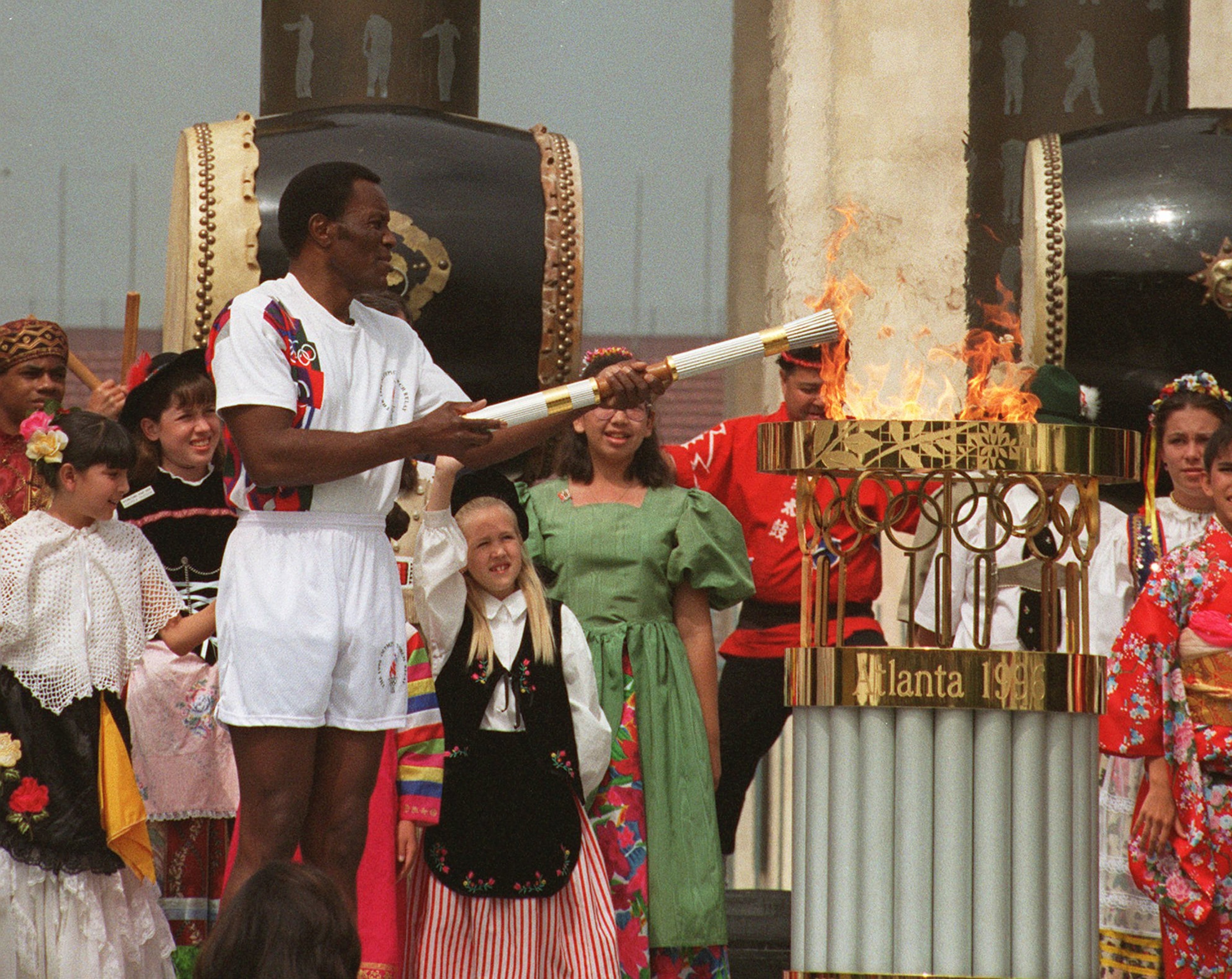
In a nod to history, Olympic decathlon champion Rafer Johnson, the last person to carry the torch on its international journey to the 1984 Summer Olympics, lights the torch from the Olympic flame after its arrival at the Los Angeles Memorial Coliseum, Saturday, April 27, 1996. Johnson was the first torchbearer during its 15,000-mile trip to the opening ceremonies in Atlanta. (Reed Saxon/AP)

In the U.S., the 1996 torch relay commenced in Los Angeles and zigzagged through 42 states over 84 days.

The flame was carried by more than 12,000 torchbearers, a mix of notable athletes including professional boxer Evander Holyfield and everyday people chosen for their community contributions.
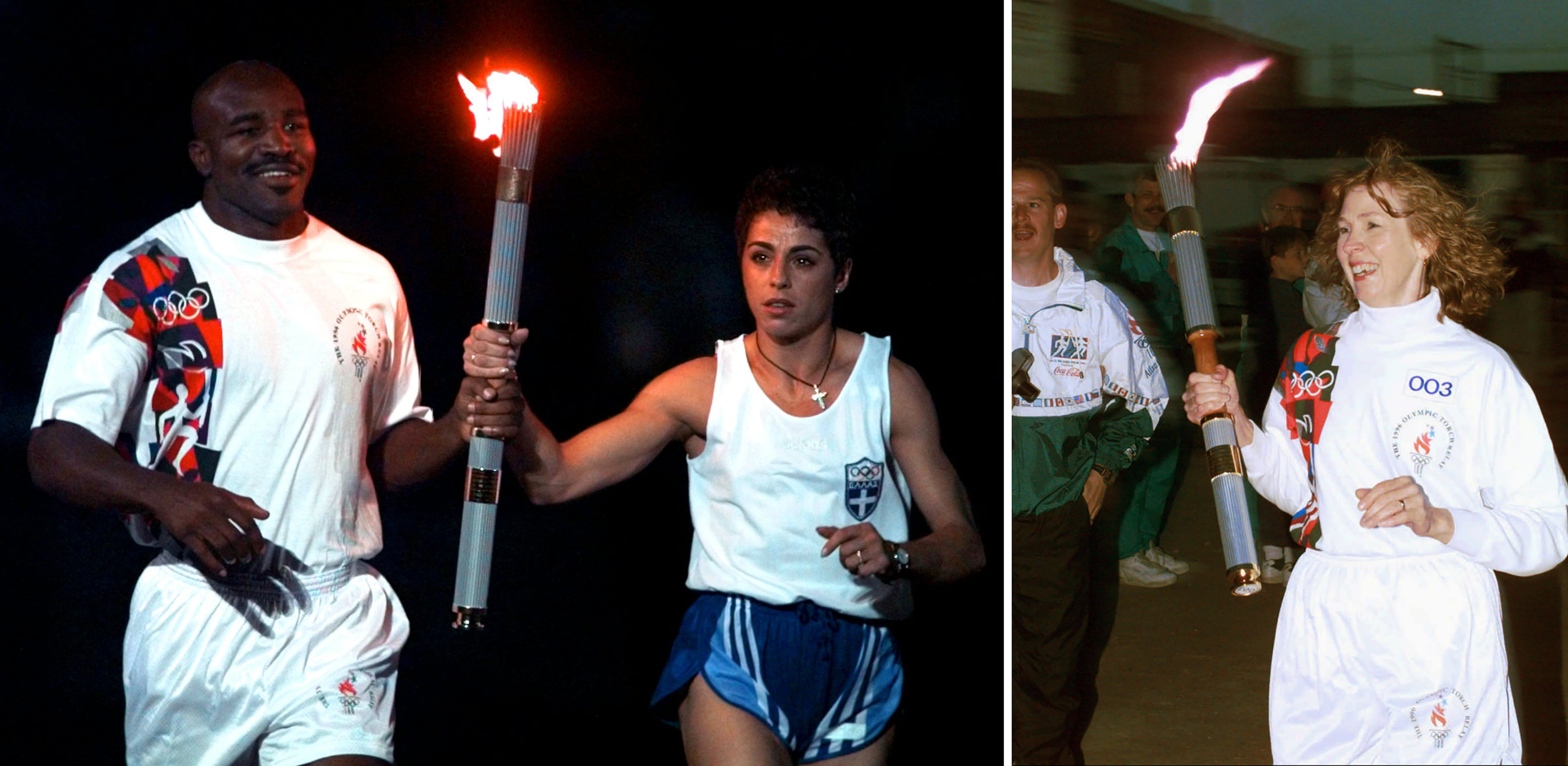
Evander Holyfield (left) carries the Olympic flame with Voula Patoulidou of Greece during the 1996 Summer Olympic Games opening ceremonies in Atlanta, Friday, July 19, 1996. At right, Ellen McGee, chosen as a "community hero" for adopting 11 kids with special needs, runs the Olympic Torch through the streets of Cheyenne, Wyoming, early Sunday morning, May 12 (Mother's Day). (Eric Draper/AP; Michael Pugh for the AJC)

Even Payne was a torchbearer.

“I chose Sanford Stadium in Athens, where I played football all those earlier years,” he said, adding he passed the torch to former Georgia Bulldogs football head coach Vince Dooley.

But the most legendary and final torchbearer of the 1996 relay was professor boxer Muhammad Ali.

His role was a well-guarded secret until the opening ceremony in Atlanta on July 19, 1996 — in what’s become an iconic moment in sports history.
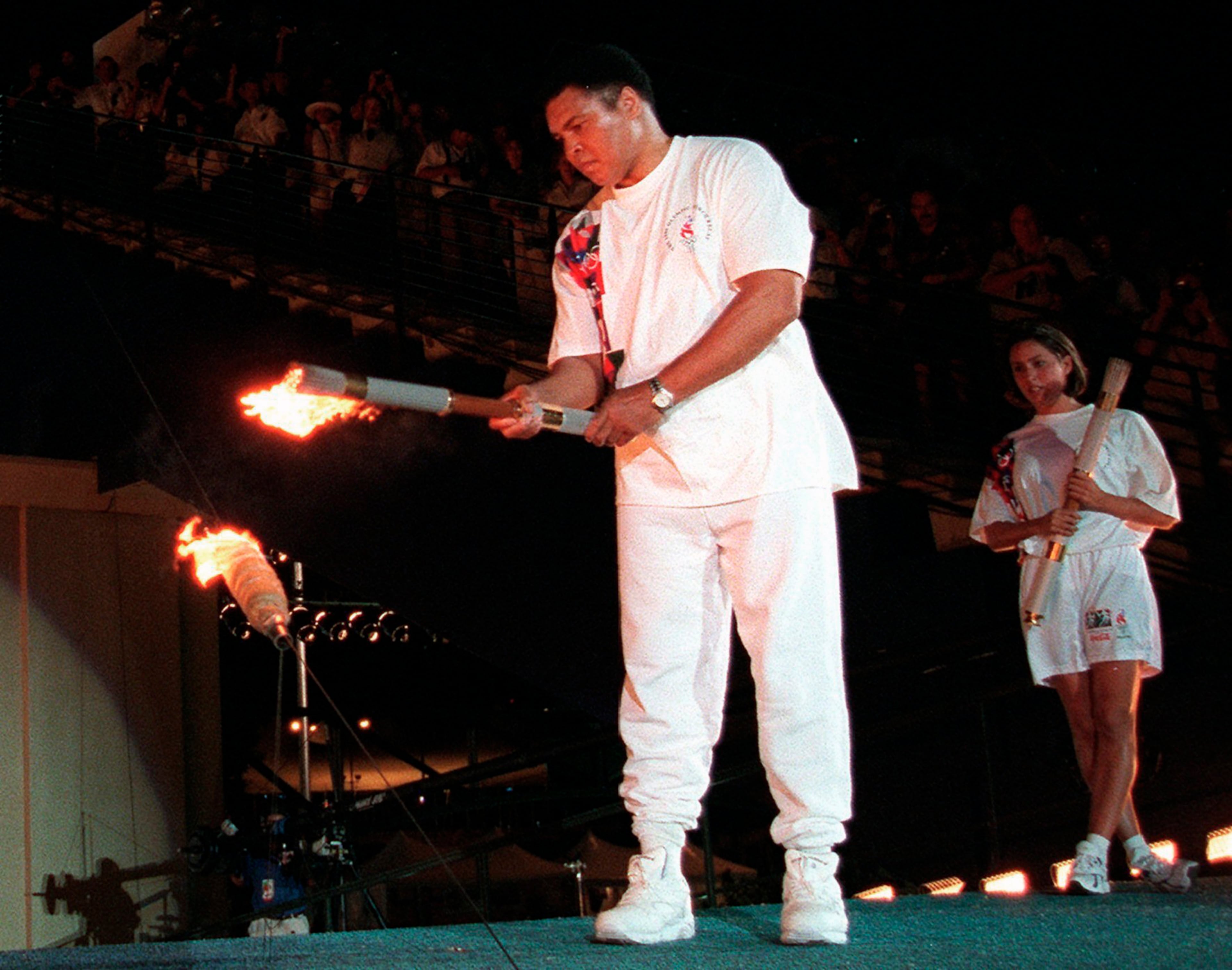
Muhammad Ali lights the Olympic flame during the 1996 Summer Olympic Games opening ceremony in Atlanta as American swimmer Janet Evans looks on, July 19, 1996. (Michael Probst/AP)

When the penultimate torchbearer, Olympic swimmer Janet Evans, lit Ali’s torch, his arms trembled as he touched the fire to a cable wick that transported the flame up to the ceremonial Olympic caldron.

Ali’s wife, Lonnie Ali, said Friday that people were visibly crying during that moment, even former President Bill Clinton had tears streaming down his face, she said.

“He thought they were crying because they felt sorry for him because he was in full display with Parkinson’s disease,” Lonnie Ali said of her late husband. “I had to convince him, ‘No, that wasn’t it at all. They were crying because they were so happy to see you out there being courageous, holding that flame high.’”

Lonnie Ali speaks during the LA28 Olympic Torch Relay Announcement at City Hall in Atlanta on Tuesday, Sept. 29, 2026. (Abbey Cutrer for the AJC)

She said Ali would later call it one of the great moments of his life. It was “a chance to remind the world that strength isn’t just what you can do with your body. It’s the courage to keep showing up,” she added.

The Atlanta Journal-Constitution chronicled the movements of the torch relay across the country that year.
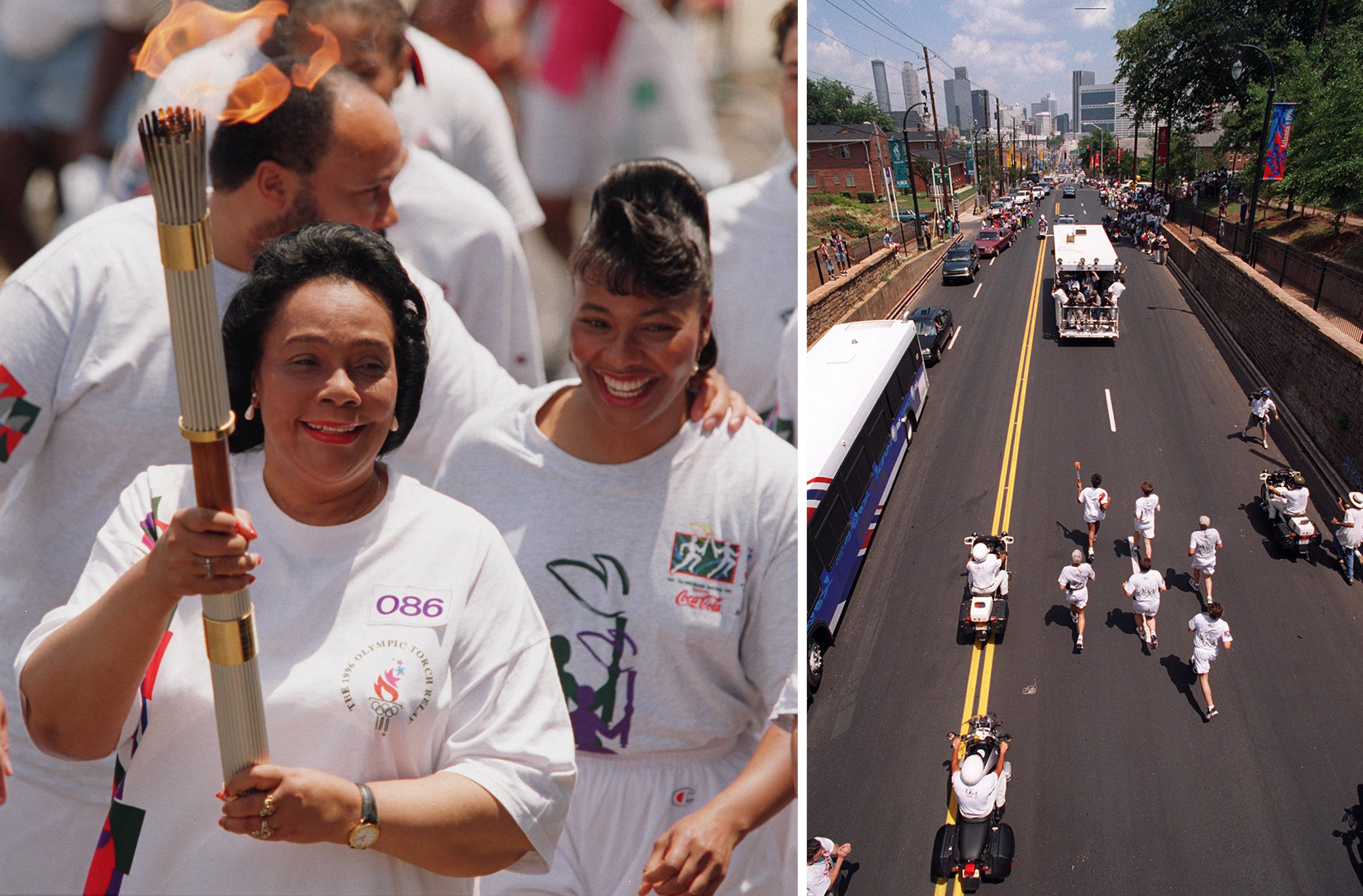
At left, Coretta Scott King carries the Olympic torch on Friday, July 19, 1996, prior to the 1996 Summer Olympic Games in Atlanta. At right on the same day, a torch runner travels under the Morris Brown College bridge, the same bridge that the coffin of Dr. Martin Luther King Jr. traveled under in 1968. (Greg Lovett/Palm Beach Post/Cox Newspapers; John Spink/AJC)

“For Atlanta, 1996 was never simply about hosting a special sporting event,” Atlanta Mayor Andre Dickens said Tuesday. “It was about showing the world who we were becoming — a modern, thriving and welcoming city too busy to hate.”

The flame traveled in creative ways, including by Pony Express. An unlit torch was also taken into the space for the first time on board the Space Shuttle Columbia.
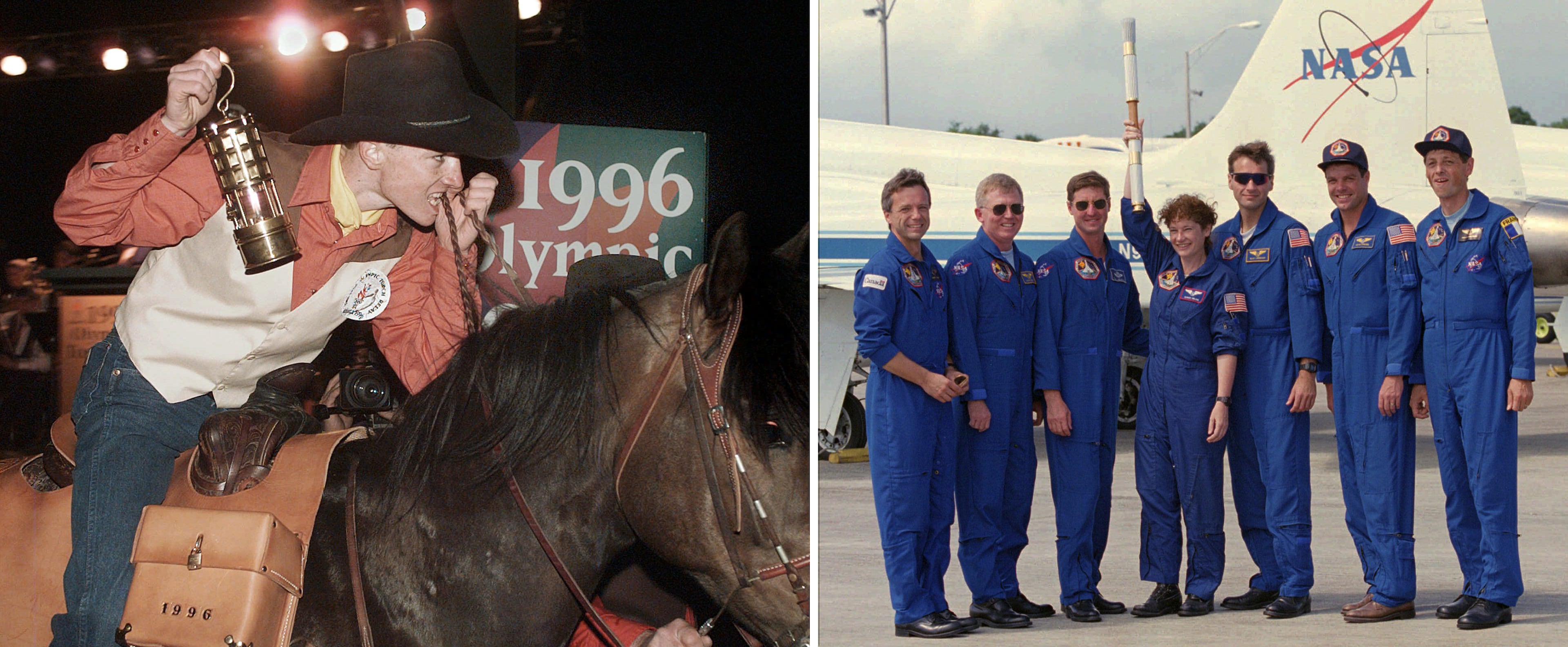
Zane Hollingsworth (left) uses his teeth to get a better grip on the reins on his horse as he carries the Olympic flame in a lantern on the Pony Express trail in Julesburg, Colo., on Monday, May 13, 1996. The Olympic flame was carried out of the state of Colorado and through Nebraska by Pony Express riders. At right, STS-78 astronauts pose with the Olympic torch at the Kennedy Space Center's Shuttle Landing Facility on Monday, June 17, 1996. The torch would later fly on the Space Shuttle Columbia. (Ed Andrieski/AP; Chris O’Meara/AP)

“It’s magical, and you don’t know it until you’re there,” Evans said Friday in an interview with the AJC. She is serving as the chief athlete officer for the 2028 Olympic Games in Los Angeles.

“I think there’s something about it that brings people together, and it brings cities together, and it inspires,” Evans said.