80 years after Moore’s Ford lynchings, grand jury transcripts must be released

For 80 years, the brutal murder of four people in Walton County has gone unsolved.
The Moore’s Ford lynchings of 1946 have been the subject of books, documentaries, court battles and closed-door conversations. Yet records from the original grand jury investigation remain hidden from the public.
One of the last avenues for bringing those records to light is the Civil Rights Cold Case Review Board, an independent federal agency created after a group of high school students began pushing for greater access to records from civil rights-era cases.
The review board is scheduled to terminate in January.
While Georgia Sen. Jon Ossoff and Sen. Ted Cruz of Texas have passed legislation to extend the board’s efforts to 2031, the reauthorization bill is still awaiting consideration by the U.S. House of Representatives.
Congress should reauthorize the board, and the grand jury transcripts from Moore’s Ford should be among the records prioritized for release.
For generations, Black and white residents of Monroe have lived under the shadow of Moore’s Ford and a code of silence surrounding what happened there.
The details of that day have been buried under years of fear and shame, even though many of the individuals who were considered suspects have died.

Releasing the records won’t undo what happened. But after 80 years, keeping them secret does nothing to help a community still trying to reckon with its past.
In July 1946, two Black couples, George and Mae Dorsey and Roger and Dorothy Malcom, were traveling to Monroe from the Walton County Jail, where Roger Malcom, a sharecropper, had been incarcerated for allegedly stabbing a white man.
As the party crossed near the Moore’s Ford bridge, a white mob pulled the couples from the car, tied them up, beat them and shot them multiple times. Dorothy Malcom was believed to have been pregnant at the time.
Dozens of white men participated in the killing mob.
None were masked.
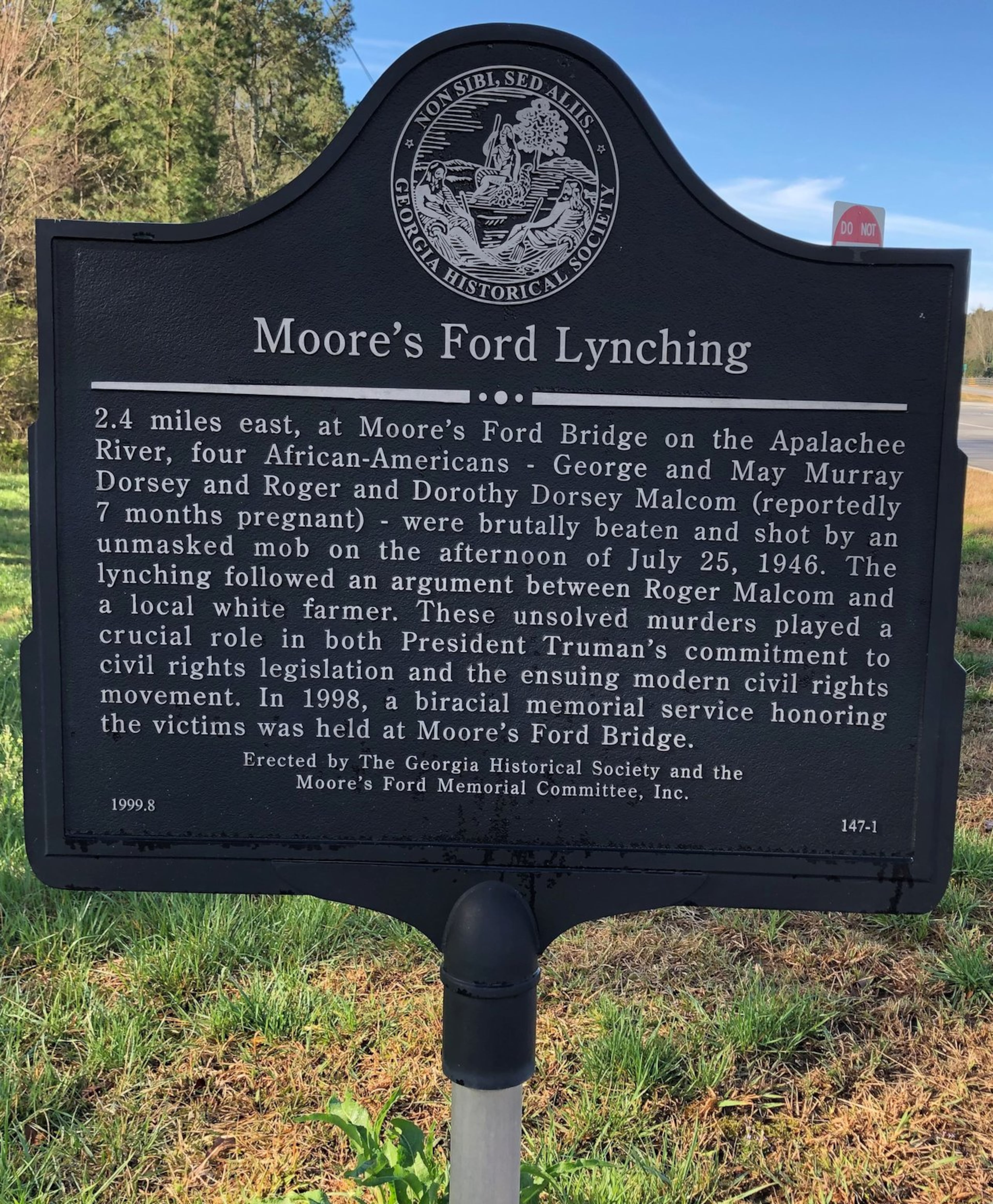
Yet no one was ever charged with the killings.
In 1947, after a four-month FBI investigation, a grand jury was unanimous in its inability to establish an identity of the killers. Records of what that grand jury heard remained out of public view.
The case went cold until a witness came forward in the early 1990s, renewing public interest and prompting then-Gov. Roy Barnes to direct the Georgia Bureau of Investigation to reopen the case and identify the murderers.
State and federal authorities spent years revisiting the case before finally closing their investigations.
In 2018, the Atlanta Journal-Constitution released the Georgia Bureau of Investigation’s report to the public.
But the original grand jury transcripts remained sealed.
In 2014, author and historian Anthony Pitch went to federal court to have them unsealed after learning the records were held by the National Archives. He initially won, but after years of appeals, the 11th Circuit ultimately ruled against their release. Pitch died in 2019, and the U.S. Supreme Court later declined to hear the case.
Government officials have argued that releasing the transcripts would violate grand jury secrecy. But Congress has already recognized the historical importance of opening records from unresolved civil rights cases by creating and funding the Civil Rights Cold Case Review Board.
The 10-year-old effort to create the review board got its start in an AP government class at a high school in Hightstown, New Jersey.
Students researching cases from the civil rights era requested records through the Freedom of Information Act but discovered the documents were heavily redacted.
Congress had already authorized a review board to release documents related to the assassination of President John F. Kennedy. Using the same language as a template, the students lobbied for congressional action to release records from civil rights era cases to the public.
The law establishing the review board passed in 2019 was later reauthorized to extend the work through 2027.
Much of the effort to keep Moore’s Ford at the forefront has been driven by residents who want to heal the unspoken rift in the community.
In 2022, I interviewed Monroe resident Stephanie Calabrese, whose documentary “Unspoken” generated a large following. She told me then, while she wasn’t sure releasing the grand jury transcripts would change anything, she knew that people in the community wanted to find a way to heal.
In a 2018 column for the Walton Tribune, Monroe resident and mental health professional Tim Schnabel offered a possible pathway to healing.
“There is never healing or the rebuilding of trust between peoples without an acknowledgment that what was done by one has caused another’s suffering,” Schnabel wrote. “Without trust one cannot feel safe. Without safety there is no real relationship because the risk of getting close is too great.”
Schnabel told me he is drafting a letter that he will share with Calabrese’s thousands of followers, asking members of Congress to reauthorize the Civil Rights Cold Case Review Board and prioritize the release of the grand jury transcripts.
The lack of urgency to bring transparency to the Moore’s Ford lynchings has become a blemish on the city of Monroe, the state of Georgia and the U.S. government.
If there is shame to be felt in what happened at Moore’s Ford, it isn’t in revealing the actions of our ancestors, as one government official suggested.
The shame is in allowing our fear of what may be uncovered to serve as a stronger motivation than justice.
Read more on the Real Life blog (www.ajc.com/opinion/real-life-blog/) and find Nedra on Facebook (www.facebook.com/AJCRealLifeColumn) and X (@nrhoneajc) or email her at nedra.rhone@ajc.com.