I reported on the Apalachee school shooting. Here’s why I felt conflicted.
My childhood home was 12 minutes down the road from Apalachee High School.
I drove past my old neighborhood off Ga. 316 on the way to Winder to report on the aftermath of the Sept. 4, 2024, school shooting in my first week as an Atlanta Journal-Constitution breaking news reporter. I went to a vigil for the victims in Winder. I attended the funeral of Ana Cristina Irimie, one of the teachers killed.
And in July, I covered the sentencing hearing of the shooter, where all of the evidence that the district attorney had gathered for a trial that won’t take place saw the light of day.
It wasn’t my high school; it wasn’t exactly my community, yet it felt close to home. I cried, quietly at home, privately processing the weight of reporting on the attack.

But as I witnessed students hold each other and cry during the vigil, family members cry at Irimie’s funeral and teenage victims wail in the courtroom hallway during the sentencing, I couldn’t help but feel like an intruder.
The weight of honoring the victims while simultaneously being the eyes and ears of the public rested on my shoulders with each story I wrote.
And as I listened in July to the prosecutors walk through the years the Apalachee High School shooter spent planning out his attack by watching court hearings, reading news articles and viewing other content from the trials of prior mass shooters so he could mimic them, the irony was not lost on me.
He wanted to pay homage to school shooters so that others would recognize his callbacks and similarly idolize him, prosecutors presented during his sentencing hearing.
Articles and broadcasts from this case bear his name and face, just as he had expected.
My work is part of that news coverage others can find online.
The balancing act: Inform vs. inflame

There’s a certain dissonance that comes with sitting on a courtroom bench and writing a news story about a boy who committed mass murder, motivated by notoriety.
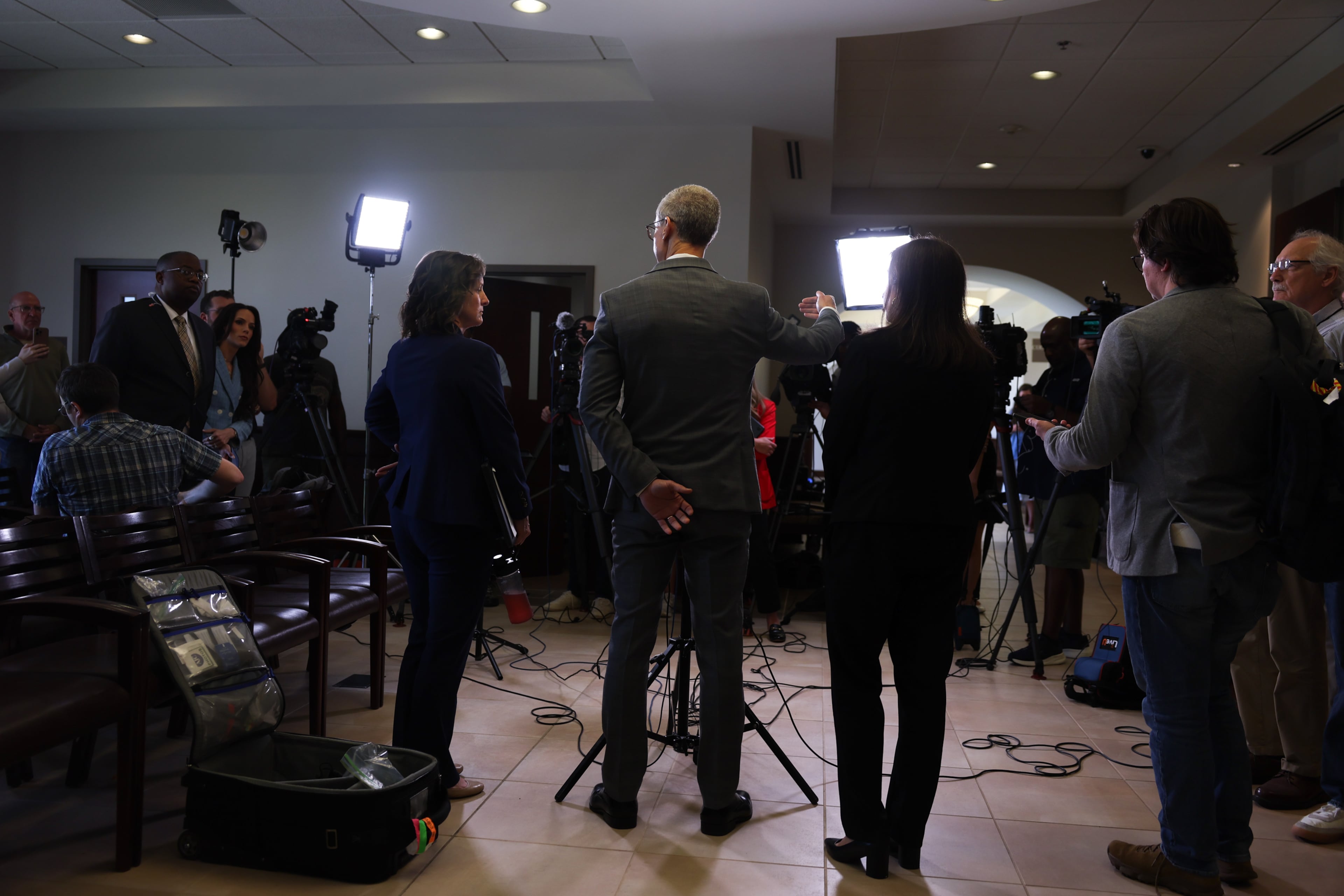
As journalists, we perform a public service. The trial of a school shooter is a story of high interest. National news outlets stationed their cameras outside the courtroom. Reporters practiced their lines before going live. Photojournalists stood to photograph the killer as he walked through the courtroom door. Writers typed frantically, trying to capture each word said in court.
And so, in covering the news, we all inevitably and unintentionally provide the notoriety that this boy so desperately sought in committing this attack.
There are things the media can do to mitigate that. After the shooting, the AJC made a decision to only use his name when absolutely necessary. We focused as much as we could on the victims and the tragedy.
But ultimately, our responsibility to be the eyes and ears of the public in these moments outweighs our desire to minimize the shooter’s infamy. How can the victims get true accountability if the evidence isn’t presented and the end result isn’t broadcast?
Reporters aren’t alone in facing this conundrum.
I talked with researchers who study the online “true crime community,” in which the shooter was immersed, for an article about what the true crime community is and how people can spot the signs of a child or teen’s involvement in it. They said they also struggle with finding the line between contributing to a shooter’s notoriety and educating the public so that people are more aware that this place exists.
“The researcher side of me really wants to shed light on this, make sure that people are informed and know exactly what we’re dealing with,” said Ben Popp, a threat analyst with the Anti-Defamation League who is embedded in the true crime community. “At the same time, you don’t want to give more fame to some of these individuals who have committed attacks.”
The Apalachee school shooter had photos of the Marjory Stoneman Douglas High School shooter hung on his wall — just one of the red flags prosecutors say his family neglected to address before the attack, and a key sign that one is developing an unhealthy obsession with mass killers, he said.
“In some cases, I think it’s important to name attackers,” Popp said. “If someone knew who Nikolas Cruz was on (Apalachee school shooter Colt) Gray’s wall, maybe that would have been enough of a warning sign.”
Katherine Keneally is the U.S. director of threat analysis and prevention at the Institute for Strategic Dialogue, a global nonprofit that researches and seeks to combat hate and extremism. She told me she doesn’t have a good answer, either.
“There’s this fine line where you aren’t giving the community more material, but at the same time, there also needs to be this education on the presence of this,” Keneally said. “Obviously, not enough people know about the TCC (true crime community), because shootings and plots keep happening.”
This online subculture obsessed with mass killers originated in the wake of the 1999 Columbine High School shooting, which had a trove of content left behind by the killers for others to find and explore. So-called “Columbiners” later evolved into the true crime community.
Investigators chose not to release some evidence in the Columbine case, most notably the “basement tapes,” for fear that they would inspire other attacks, Keneally said. The tapes were later destroyed, the sheriff’s office said, according to media reports at the time.
“But at the end of the day, obviously, that didn’t really have any real impact on discrediting their influence, or preventing them from having influence in the first place,” Keneally said of the Columbine shooters.
Enlightening is the goal
Columbine inspired more than 80 copycat attacks, according to an FBI documentary from 2019 called “Echoes of Columbine,” which marked the 20-year anniversary of the massacre.
I was born in fall of 1999, a few months after the Columbine High School shooting. I have never known a world without school shootings. I have known the fear that students feel in worrying about the possibility of a school shooting.
Thankfully, I have never experienced one.
And so, I sit on a different row in court from the victims of the Apalachee school shooting, who grew up in a neighboring community to mine, and choose not to approach them in this moment, because this moment is painful. My reporting, inevitably, contributes to the notoriety of the person who caused them unbearable heartache.
But I can write judiciously and hope readers see my intent: not to bring fame to a mass killer, but to inform the parents and teachers of the next shooter of the potential warning signs so that they may intervene before tragedy strikes yet again.
After the sentencing hearing, I asked Barrow County DA Brad Smith: “Are you concerned, or did you ponder at all, the elements at trial that could be looked at in the future by future children in these sites, evaluating this and idolizing it in the same way he did?”
He replied: “Absolutely, and we know that’s going to happen. We weighed that, we talked with experts about it and we ultimately landed on: It is more important for the rest of society to know this dark, ugly place exists so that we can start doing something as a society to fix it.”
Taylor Croft is a reporter on the crime, courts and breaking news team at The Atlanta Journal-Constitution.
Send letters to the editor of 250 words or fewer with your name, city or town and contact information to letters@ajc.com.