America at 250: First-generation Americans lean into their parents’ cultures

My childhood was more star-spangled than most.
I grew up on an Army base, a tight-knit community encircled by barbed wire and ensconced in the patriotic mores of the U.S. military. Even though it was the late 1990s and early aughts, we watched reruns of “The Andy Griffith Show” on government-run television and listened to Paul Harvey on government-run radio.
My teachers were Vietnam War veterans and my friends’ parents were active duty soldiers and sailors. Nearly everyone in my community — including my dad, a civilian engineer who spent his career with the Army — dedicated their lives in some way to the service of the nation.
This explains some of my deep love of country — but it’s only part of the story.
I am also the child of immigrants. My mother is from the Philippines and my father is from India. Growing up, I had a hard time fitting in. I didn’t feel Filipino enough to hang with the Filipinos, and I didn’t know any other Indians.
It was an odd ethnic combination — a mashup of cultures and contradictions. My mother was Catholic, my father Hindu; my mom an omnivore, my dad vegetarian (at least until they met); they grew up speaking different languages, with English as the mediator. Because of my dad’s job I didn’t have any regional ties either. I moved four times — from Illinois to Japan to Georgia and back to Japan — before I was 13.

Bridging traditions from the old land to the new
America at 250 essays: Read more from Georgians celebrating Independence Day
In May, the AJC started publishing publishing Opinion essays to commemorate the 250th anniversary of the United States’ Declaration of Independence.
- America at 250: Georgia cities like Eatonton restore our faith in democracy (By AJC Opinion Editor David Plazas)
- America at 250: Celebrate independence by remembering the ladies of Georgia (Margaret E. Holt of Watkinsville, Suzanne M. Minarcine of Macon, Madeline Van Dyck of Athens and Marilyn Vickers of Athens
- America at 250: Civic hygiene can save election integrity in Ga. and beyond (Lori Ringhand, UGA law professor and author of “We the Voters”)
- America at 250: Dr. King’s Prince Hall reminds us to honor the whole story (Carrie Besnette Hauser and Phillip June, Trust for Public Land)
- America at 250: KKK granite from Georgia built U.S. Treasury. Trump wants you to forget that. (Bethany Luchetta, a Daughter of the American Revolution)
- America at 250: Georgians put aside political differences for one night (Keith Strigaro, Georgia Historical Society)
- America at 250: My immigrant clients believe in U.S. system. We should too. (Mills Fleming, immigration attorney in Savannah)
- America at 250: Adams, Jefferson disagreed to the end on Revolution’s meaning (Marianne Holdzkom, Kennesaw State University professor)
- America at 250: Thanks to civics educators for forming the nation’s future (David Bobb, president and CEO, Bill of Rights Institute)
- America at 250: How to live the ‘Georgia Way’ as a discipline for public life (Chris Clark, CEO, Georgia Chamber of Commerce)
- America at 250: First-generation Americans lean into their parents’ cultures (AJC Photojournalist Arvin Temkar)
- America at 250: Atlanta created the model for civil rights and prosperity (John Hope Bryant, CEO of the Operation HOPE)
- America at 250: Celebrating 2-1/2 centuries of disagreeing about our democracy (Page Alexander, CEO, The Carter Center)
- America at 250: Expand who is seen, who is heard and who has opportunity (By Margaret Mitchell, CEO of YWCA USA, and Danita V. Knight, CEO of YWCA Greater Atlanta)
- America at 250: Was slavery wrong? Museums must now answer that question. (Yaba Baker, a fourth-generation grandson of David Drake, aka Dave the Potter)
From far across the ocean, on the Army base, I found my identity in being American. After all, America is a nation of immigrants. Where else could my parents have formed such an unlikely union?
They make rom-coms about this kind of made-in-the-USA culture clash: “My Big Fat Greek Wedding,” anyone? America — with its lofty ideals and promise of a better life — was the place that made me possible.
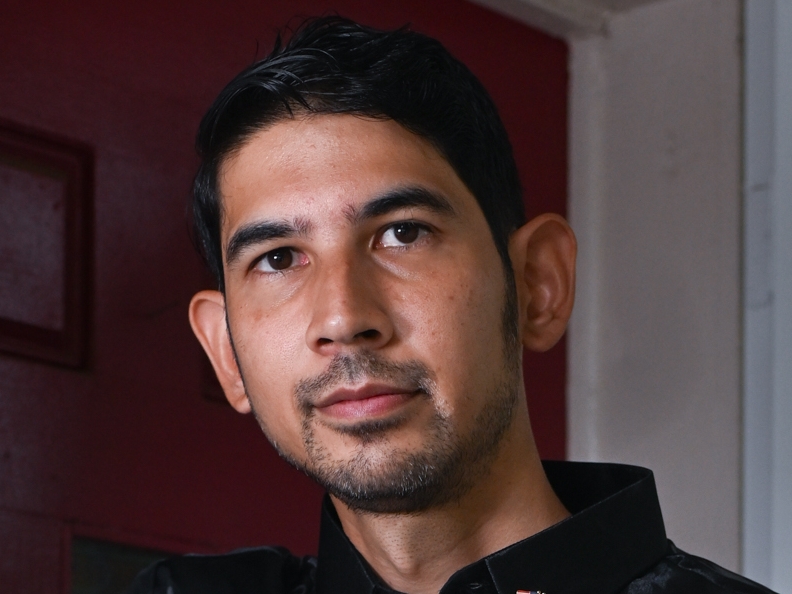
As a photojournalist for the AJC, I wanted to mark America’s 250th anniversary with a project that celebrates the country and its people and, in particular, people like me: first-generation Americans, who have at least one immigrant parent.
I photographed a series of portraits of people wearing traditional attire from their heritage in Atlanta locations that are meaningful to them. My goal was to showcase how first-generation Americans bridge traditions from the old land and the new, while letting my participants share their experiences inhabiting this special in-between place.

A guiding metaphor for the project was the “American mosaic.” Like a work of art assembled tile by tile, we are built of cultures, ethnicities and ideas from around the world. First-generation Americans are uniquely positioned to understand this because they are raised American but are also often steeped in the cultures of their parents’ home countries.
My mom cooked pancit noodles and sinigang soup; spoke to me in Visayan, the dialect of her home island; and flew me abroad to visit relatives, like my uncle with the pet monkey and parrot.
Consider what unites, rather than divides, us
Even though I didn’t always appreciate my heritage when I was growing up, I’ve come to realize that it is something to be celebrated alongside my Americanness.

This is common sentiment among the many ethnic groups in the country: Irish Americans, for example, have turned what was once a religious holiday into a commemoration of history and culture so spectacular that even I am proud to wear green on St. Patrick’s Day.
In telling the stories of first-generation Americans I aim to highlight all Americans, because nearly everybody is descended from an immigrant — or a person who was brought here against their will. Our history is complicated and sometimes tragic, but at its best it is a testament to the qualities that inspired my parents and other immigrants to leave their homes to make a new one.
On this July Fourth, I invite readers to consider what unites us rather than what divides us. A mosaic, like these United States, is the sum of many parts — parts that, when bonded together, can uphold a vision that lasts 250 years and more.
Arvin Temkar is a staff photojournalist at the AJC.
Send letters to the editor of 250 words or fewer with your name, city or town and contact information to letters@ajc.com.