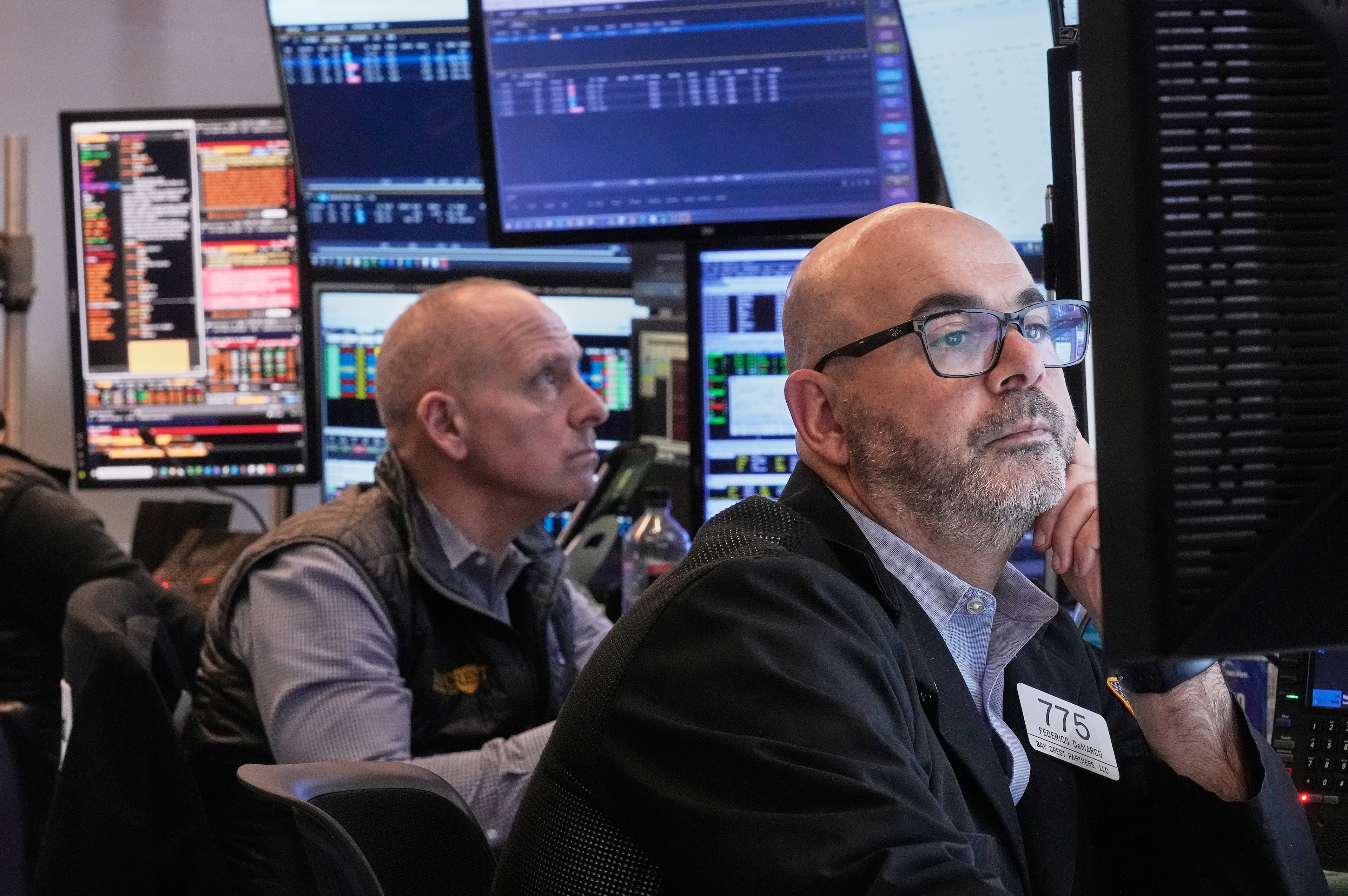
Asian shares slip after Wall Street pulls back from its record heights

BANGKOK (AP) — Asian shares mostly fell Tuesday after U.S. stocks pulled away from their record heights, while U.S. futures edged higher.
Tokyo's Nikkei 225 index was the main outlier, gaining 0.2% to 50,691.39.
Chinese markets declined as investors watched for news from the Central Economic Work Conference, an annual planning meeting of the ruling Communist Party's leadership.
Hong Kong's Hang Seng lost 0.8% to 24,549.54, while the Shanghai Composite index inched 0.1% lower, to 3,918.83.
In South Korea, the Kospi lost 0.3% to 4,140.44 and the Taiex in Taiwan fell 0.5%.
The S&P/ASX 200 in Australia gave up 0.2% to 8,607.80 after the Reserve Bank opted to keep its cash rate unchanged at 3.6%.
Computer chip giant Nvidia's shares climbed 2.3% in afterhours trading after President Donald Trump said he will allow it to sell its H200 computer chip used in the development of artificial intelligence to “approved customers” in China. Trump said Monday on his social media site that he had informed China’s leader Xi Jinping and “President Xi responded positively!”
Nvidia's shares rose 1.7% on Monday.
The move has wide potential ramifications, experts said.
“This would allow China to speed up its buildout of AI infrastructure and increase the likelihood of Chinese AI models matching, or possibly even overtaking, frontier U.S. models,” Julian Evans-Pritchard of Capital Economics said in an analysis.
Investors are awaited a meeting of the Federal Reserve on Wednesday, where the U.S. central bank is expected to cut its benchmark interest rate to help counter a weakening jobs outlook.
On Monday, the S&P 500 slipped 0.3% for its second loss in 11 days, but it remains within 0.6% of its all-time high set in October. It closed at 6,846.51.
The Dow Jones Industrial Average dropped 0.4% to 47,739.32, and the Nasdaq composite edged 0.1% lower to 23,545.90.
Netflix dropped 3.4% after Paramount announced a bid in hopes of trumping Netflix’s deal to buy Warner Bros.
Paramount said it’s offering $30 for each Warner Bros. Discovery share, as well as a quicker and easier way for investors to get their payout. Paramount is offering to buy all of Warner Bros. Discovery in cash, unlike Netflix’s offer of cash and stock for just Warner Bros. following its pending split with Discovery.
The board of directors for Warner Bros. Discovery had agreed to Netflix’s offer last week, but it’s already facing potential scrutiny from federal regulators. President Donald Trump said Sunday that a Netflix-Warner Bros. combination “could be a problem” amid worries about too much industry power sitting at one company
Warner Bros. Discovery rose 4.4% following the hostile buyout bid, and Paramount Skydance’s stock climbed 9%.
Elsewhere on Wall Street, Confluent soared 29.1% after IBM said it would buy the company, which helps customers connect and process data. IBM said the $11 billion deal will help customers deploy artificial-intelligence tools better and faster, and its shares added 0.4%.
The U.S. stock market has calmed following weeks of volatility.
Inflation has stubbornly remained above the Fed’s 2% target, and Fed officials are notably split in their opinions about whether high inflation or the slowing job market is the bigger threat to the economy.
In other dealings early Tuesday, U.S. benchmark crude oil lost 18 cents to $58.70 per barrel, while Brent crude, the international standard, fell 13 cents to $62.36 per barrel.
The U.S. dollar rose to 155.96 Japanese yen from 155.92 yen. The euro climbed to $1.1646 from $1.1638.
___
AP Business Writers Matt Ott and Stan Choe contributed.